If your business manufactures, imports, or sells goods in plastic packaging, you may be legally required to register under India’s Extended Producer Responsibility (EPR) framework for plastic waste. This guide explains who must register, where to register in 2026, what documents and fees are involved, and- just as importantly- what you must keep doing after registration.
Important 2026 update: CPCB’s earlier standalone Plastic EPR Portal (eprplastic.cpcb.gov.in) has been discontinued and its functions moved into the CPCB Common EPR Portal, which now hosts a dedicated Plastic EPR Registration module. If you’ve read older articles that describe a separate plastic-only portal, that description is now out of date. Businesses that were registered on the old portal need to confirm their data has carried over correctly rather than assuming the migration was automatic and error-free.
Quick Summary
- EPR registration for plastic packaging is required for Producers, Importers, and Brand Owners (together called PIBOs) and for Plastic Waste Processors, under the Plastic Waste Management Rules, 2016, as amended.
- Registration now happens through CPCB’s Common EPR Portal, not the older standalone plastic portal.
- Businesses operating in only one or two states are generally routed to the relevant State Pollution Control Board or Pollution Control Committee rather than being processed centrally by CPCB.
- Getting registered is only the starting point — you then carry ongoing obligations for recycling/collection targets, mandatory recycled-content percentages (a 2026 addition), and annual reporting.
- Government fees, exact processing timelines, and category definitions change with each amendment, so always confirm current figures on the official portal before you apply or budget.
Table of Contents
What Is EPR Registration for Plastic Waste?
Extended Producer Responsibility is the legal principle that whoever puts plastic packaging into the Indian market is also responsible for ensuring that an equivalent amount of that packaging is collected, recycled, reused, or otherwise disposed of safely after use — not just the municipal authority or the consumer.
The obligation is built into the Plastic Waste Management Rules, 2016 (notified under the Environment (Protection) Act, 1986), which have been amended repeatedly since then. The EPR framework specifically was inserted through the Plastic Waste Management (Amendment) Rules, 2022, which added detailed EPR guidelines covering Producers, Importers, and Brand Owners.
“EPR registration” refers to formally registering with the pollution control authority (CPCB, or the relevant State Pollution Control Board / Pollution Control Committee) so that your business receives a registration number, can report the plastic packaging it introduces into the market, and can demonstrate that it is meeting its EPR obligations through Plastic Waste Processors and EPR certificates.
It is worth separating two related but different ideas early on:
- EPR registration covers plastic packaging introduced into the market by Producers, Importers, and Brand Owners.
- Businesses handling other plastic products (not packaging) fall under different provisions of the Plastic Waste Management Rules and may have separate obligations, such as those relating to plastic raw materials, resins, and intermediates covered by the 2024 amendment.
If you are unsure which category your business falls into, that classification question should generally be resolved before you attempt registration, since it determines the information and documents you will need to submit.
Who Needs EPR Registration for Plastic Packaging?
The rules use four defined roles, and most businesses fall into at least one of them:
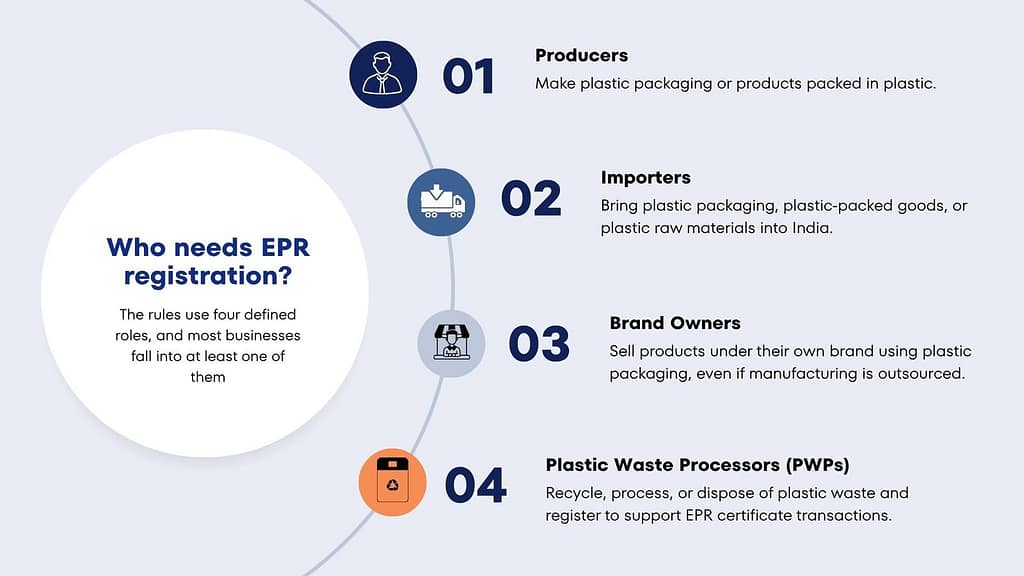
Producers manufacture plastic packaging material or manufacture goods packed in such packaging, including converting raw plastic into packaging material for others to use.
Importers bring plastic packaging, or goods packaged in plastic, into India. Following the 2024 amendment, the importer definition was expanded to also capture plastic raw materials such as resins, pellets, and intermediate materials.
Brand Owners sell products under their own brand using plastic packaging, even where the actual manufacturing or packaging is outsourced to a third party.
Plastic Waste Processors (PWPs) are entities engaged in recycling, co-processing, or end-of-life disposal of plastic waste, and they also register so that PIBOs can purchase EPR certificates for the waste these processors have handled.
A single business can fall into more than one category — for example, a company that both manufactures its own packaging and sells finished goods under its own brand may need to consider its obligations under more than one role.
Do I need registration? A starting checklist
| Business situation | Likely EPR relevance | Who to check with |
|---|---|---|
| You manufacture plastic packaging material or convert plastic into packaging | Producer obligations likely apply | CPCB / relevant SPCB or PCC |
| You import plastic packaging, or goods packed in plastic, or plastic raw material | Importer obligations likely apply | CPCB / relevant SPCB or PCC |
| You sell products under your own brand in plastic packaging, even if manufactured by a third party | Brand Owner obligations likely apply | CPCB / relevant SPCB or PCC |
| You recycle, co-process, or otherwise handle end-of-life plastic waste | Plastic Waste Processor registration likely applies | CPCB / relevant SPCB or PCC |
| You are a very small enterprise with limited plastic packaging volumes | You may qualify for a threshold-based exemption — this must be checked against the current rules and is not automatic | Verify current criteria before assuming exemption |
Do not assume that “being an MSME” by itself exempts a business from EPR obligations. Some smaller entities may fall below applicable thresholds, but the exemption depends on specific criteria under the current rules, not simply on business size or MSME registration status. If your volumes are close to any threshold, it is worth confirming your position directly rather than relying on a general assumption.
Businesses that operate in only one or two states are typically routed for processing to the relevant State Pollution Control Board or Pollution Control Committee rather than being handled centrally by CPCB, reflecting the jurisdictional split built into the framework. Pan-India operators are generally processed by CPCB itself.
Also Read: Actual Cost Breakdown of Pvt Ltd Company Registration in India.
Which Plastic Packaging Is Covered Under EPR?
The rules classify plastic packaging into categories so that recycling, reuse, and recycled-content obligations can be set separately for each type. The most consistently referenced categories are:
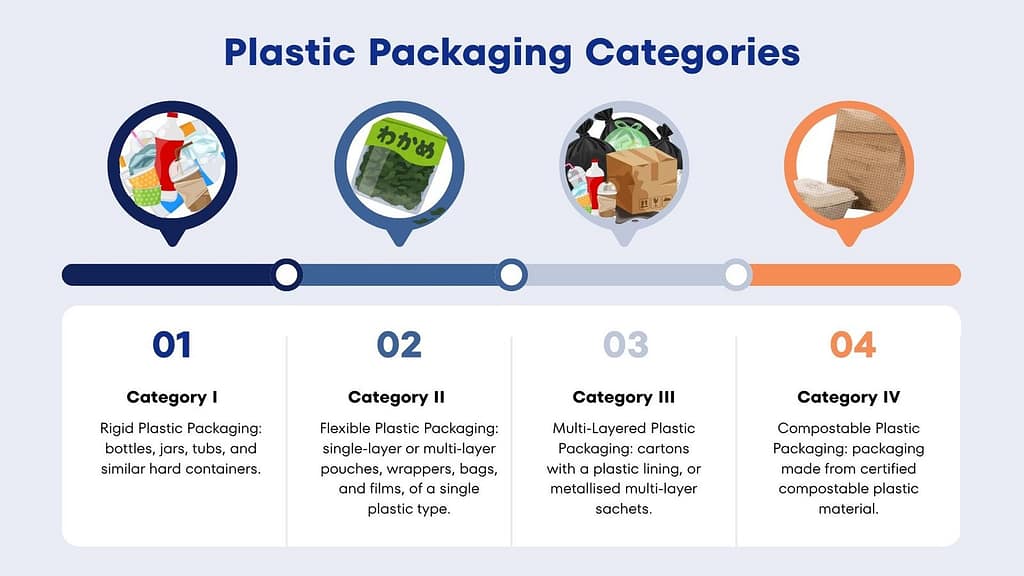
- Category I — Rigid Plastic Packaging: bottles, jars, tubs, and similar hard containers.
- Category II — Flexible Plastic Packaging: single-layer or multi-layer pouches, wrappers, bags, and films, of a single plastic type.
- Category III — Multi-Layered Plastic Packaging: packaging combining more than one material layer, at least one of which is plastic (for example, cartons with a plastic lining, or metallised multi-layer sachets).
- Category IV — Compostable Plastic Packaging: packaging made from certified compostable plastic material.
Some more recent industry commentary also refers to further sub-classifications (including for biodegradable packaging distinct from certified compostable packaging, and for certain industrial or transit packaging). Because the exact scope and numbering of these additional categories is still being clarified in practice and is not uniformly described across current sources, businesses using packaging that isn’t clearly rigid, flexible, multi-layered, or certified-compostable should confirm the correct classification directly on the Common EPR Portal or with the relevant pollution control authority before filing, rather than guessing.
A related point businesses often miss: category classification affects not just registration, but the recycling, reuse, and recycled-content targets that apply to you going forward (explained further below). Getting the category wrong at registration can create downstream reporting problems.
Where to Register in 2026: The Common EPR Portal
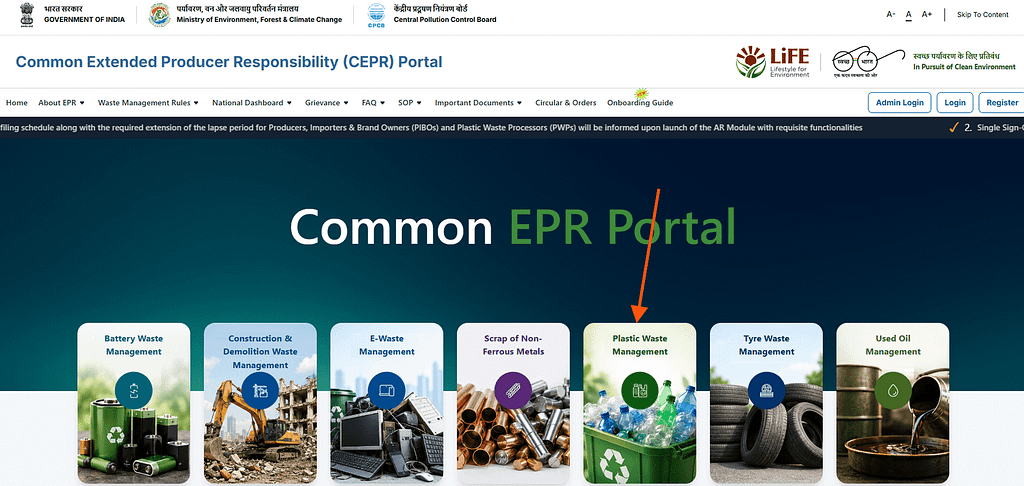
CPCB previously operated a dedicated Plastic EPR Portal. That standalone portal has been discontinued, and its plastic-packaging registration function has been migrated into CPCB’s Common EPR Portal– a unified platform that also covers other EPR waste streams such as e-waste, battery waste, waste tyres, and used oil, accessible through a single sign-on system with one Common EPR ID (CEPR ID).
If you already had an account on the old portal
CPCB’s guidance is that existing registration data has been carried over to the Common EPR Portal, and that businesses re-registering or logging in for the first time on the new system should use the same Authorized Person PAN and Company PAN that were used on the old portal, so that the system can correctly link migrated records to your account.
Do not treat this as a routine login change. Before you file any return, amendment, or renewal on the new system, check that your migrated details- registration number, packaging categories, past filings, and PAN details- appear correctly. If anything looks missing or mismatched, resolve it with CPCB before submitting further filings, since errors at this stage can affect annual returns, certificate trading, and renewals later.
CPCB vs SPCB/PCC
Applications from businesses operating across many states are generally processed by CPCB. Applications from businesses confined to one or two states are typically directed to the concerned State Pollution Control Board (SPCB) or Pollution Control Committee (PCC) for that state or union territory. This jurisdictional split existed before the portal migration and continues to apply, though the application itself is submitted through the common digital system.
Also Read: How to File a Trademark Objection Reply Online in India
Documents Required for Plastic EPR Registration
Document requirements differ depending on whether you are registering as a Producer, Importer, Brand Owner, or Plastic Waste Processor. The following is a general guide- always check the current document checklist on the portal for your specific category, since requirements can be adjusted.
Documents generally common to most applicants:
- Certificate of incorporation or business registration proof
- PAN of the company and PAN of the authorized signatory
- GST registration certificate
- Details of plastic packaging introduced into the market (category-wise quantity, typically for the current and preceding year where applicable)
- A plastic waste management plan describing how EPR obligations will be met, including engagement with registered Plastic Waste Processors
Importer-specific:
- Import Export Code (IEC)
- Bill of entry or equivalent import documentation demonstrating the plastic packaging or raw material imported
Producer-specific:
- Manufacturing consent/authorization issued by the relevant pollution control authority, where applicable to the facility
Plastic Waste Processor-specific:
- Authorization or consent for the recycling/processing/co-processing facility
- Details of installed processing capacity
If applicable, depending on your situation:
- Details of any brand licensing or franchise arrangements, where a third party manufactures under your brand
- Certification for compostable plastic packaging, where relevant
Because document lists are periodically revised, confirm the current checklist on the Common EPR Portal at the time you apply rather than relying solely on this list or on any third-party website’s list.
How to Register for Plastic EPR Online
The following describes the general sequence of a plastic EPR registration. Exact screen names, button labels, and form fields on the Common EPR Portal may differ from what is described here, since government portal interfaces are periodically redesigned – treat this as a description of the process stages, not a literal screenshot walkthrough.
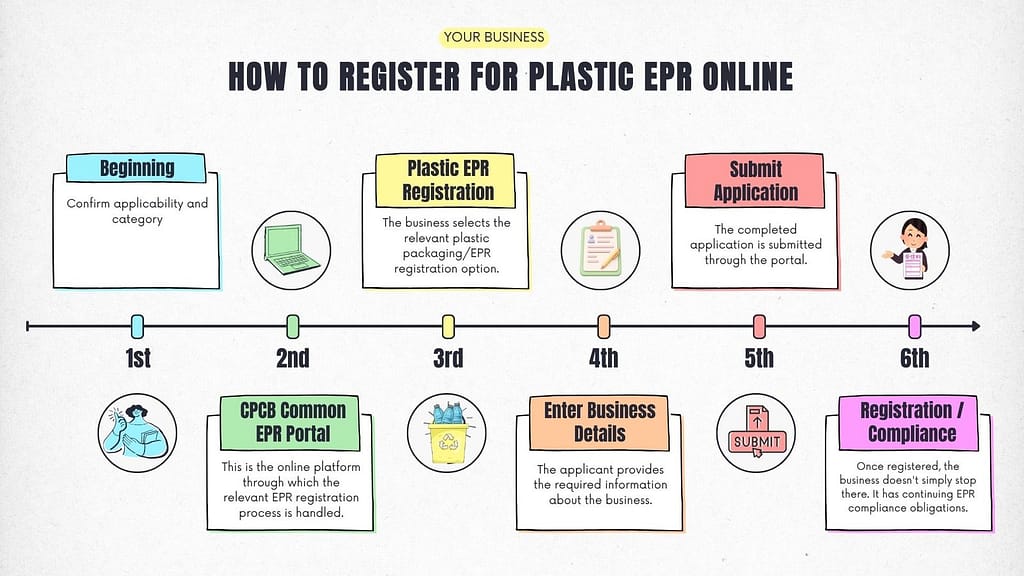
Step 1: Confirm applicability and category
Before creating an account, determine whether your business falls under Producer, Importer, Brand Owner, or Plastic Waste Processor definitions, and identify which plastic packaging categories apply to what you manufacture, import, or sell.
Step 2: Create or access your account on the Common EPR Portal
New applicants create an account using company and authorized-person details. Businesses migrating from the old plastic portal should use the same PAN details used previously, as described above.
Step 3: Enter business and packaging information
This typically includes company details, GST and PAN information, plant/facility locations if relevant, and category-wise plastic packaging quantities introduced into the market.
Step 4: Upload supporting documents
Upload the documents applicable to your category, as outlined above, in the format specified by the portal.
Step 5: Submit the application and pay the applicable fee
Once the application is complete, it is submitted online along with payment of the applicable registration fee (see the cost section below).
Step 6: Respond to queries or clarifications, if raised
The reviewing authority (CPCB or the relevant SPCB/PCC) may raise clarifications or request additional information before processing the application further.
Step 7: Receive registration/EPR ID on approval
Once approved, you receive a registration number/Common EPR ID, which is then used for annual reporting, EPR certificate transactions, and further compliance filings.
Processing does not always move through these stages at a fixed pace- see the note on timelines below.
How Much Does Plastic EPR Registration Cost?
Cost information for EPR registration should be treated carefully, because online sources frequently blur together three very different things: government fees, ongoing compliance costs, and consultant/professional service charges.
Government application fee
A fee structure commonly reported by industry and consultancy sources for PIBO registration is tiered by the annual quantity of plastic packaging placed on the market (broadly, lower fees for smaller quantities and higher fees for larger quantities), and a separate tiered structure – commonly reported around ₹5,000 to ₹50,000 depending on processing capacity – is often cited for Plastic Waste Processor registration.
These figures are not confirmed here as the current official fee schedule. Because registration fees can be revised and are now administered through a newly migrated portal, verify the exact, current applicable fee directly on the Common EPR Portal, or through the official CPCB fee schedule, before you budget for or make any payment. Do not rely on a third-party website’s fee table as proof of the government’s current charge.
Other costs to budget for
- EPR certificate costs: Ongoing costs of acquiring EPR certificates from registered Plastic Waste Processors (or through the certificate trading mechanism now formalized under the rules) to meet your annual recycling/recycled-content obligations. These vary with market conditions and are not fixed government fees.
- Compliance and reporting costs: Internal or outsourced cost of maintaining records, filing annual returns, and preparing for audits by Registered Environment Auditors.
- Consultant/professional fees: Many businesses use compliance consultants to prepare and file EPR applications. These service charges are set by the consultant, are entirely separate from statutory government fees, and should never be assumed to represent the official registration cost.
If you’re comparing quotes or estimates from different sources, ask explicitly whether a quoted figure is the government fee, a certificate purchase estimate, or a service provider’s professional charge- the three are frequently conflated in marketing material.
Also Read: Real Govt & Attorney Fees for Trademark Registration in India
What Happens After EPR Registration?
Once registered, PIBOs are generally expected to:
- Meet category-wise recycling/collection targets for the plastic packaging quantities they have introduced into the market.
- Meet recycled-content requirements — a significant addition under the 2026 amendment (detailed in the next section), requiring a minimum percentage of recycled plastic to be used in new packaging for Categories I, II, and III, on a rising scale through 2028–29.
- Meet reuse obligations for certain rigid packaging (Category I), particularly for larger containers such as drinking-water packaging, again on a phased scale.
- File annual returns reporting quantities introduced, collected, recycled, and disposed of, and demonstrating how obligations were met (typically through EPR certificates obtained from registered Plastic Waste Processors or purchased through the certificate mechanism).
- Maintain records supporting these filings, since compliance can now be verified through audits conducted by Registered Environment Auditors, a category of auditor recognized under the 2026 amendment.
- Comply with labelling/disclosure requirements, following a 2025 amendment mechanism under which specified packaging information can be provided through a QR code, barcode, product information brochure, or a qualifying unique identifier, reported to CPCB.
Plastic Waste Processors, correspondingly, must operate within their registered capacity, issue EPR certificates only for the plastic waste they have genuinely processed, and maintain the records needed to support those certificates.
Key Plastic EPR Changes Businesses Should Know About in 2026
The plastic EPR framework has been amended almost every year since 2022, and the changes compound rather than replace each other.
| Year | Development |
|---|---|
| 2016 | Plastic Waste Management Rules notified, establishing the base regulatory framework. |
| 2022 | EPR guidelines for plastic packaging inserted, defining Producer/Importer/Brand Owner obligations and the registration/certificate system. |
| 2024 | Framework expanded, including a broadened importer definition covering plastic raw materials such as resins and pellets, and additional packaging category coverage. |
| 2025 | A labelling/disclosure mechanism introduced, allowing specified packaging information to be provided via QR code, barcode, product brochure, or a qualifying unique number, reported to CPCB; a specific penalty provision under the rules was also inserted. |
| 2026 | A substantial amendment introduced mandatory recycled-content targets for Categories I–III, expanded reuse obligations for rigid packaging, recognition of Registered Environment Auditors for compliance verification, a formal EPR certificate trading mechanism, and migration of registration to the Common EPR Portal. |
Recycled-content targets (2026 amendment)
For the first time, PIBOs are required to use a minimum percentage of recycled plastic content in new packaging, rising over successive years:
| Category | 2025–26 | 2026–27 | 2027–28 | 2028–29 onward |
|---|---|---|---|---|
| Category I (Rigid) | 30% | 40% | 50% | 60% |
| Category II (Flexible) | 10% | 10% | 20% | 20% |
| Category III (Multi-layered) | 5% | 5% | 10% | 10% |
The rules also provide for a carry-forward mechanism where a shortfall in one year can be made up over subsequent years (generally requiring at least a portion of the shortfall to be cleared each year), and for exemptions where recycled content use conflicts with other applicable safety standards, such as food-contact requirements.
Reuse obligations
Category I rigid packaging, especially larger containers such as drinking-water packaging, now carries phased reuse targets that increase over the same 2025–26 to 2028–29 period. The exact percentage varies by container size and packaging type, so confirm the applicable figure for your specific packaging against the current rules rather than assuming a single uniform percentage across all rigid packaging.
Certificate trading
A formal mechanism now allows PIBOs that fall short of their obligations to acquire tradable EPR certificates from businesses that have exceeded their targets, rather than relying solely on direct engagement with processors.
What Happens If a Business Doesn’t Comply?
Non-compliance can arise at two different stages:
- Failing to register at all, when your business is covered by the rules, leaves you operating without the legal authorization the rules require.
- Failing to meet ongoing EPR targets after registration (recycling, recycled content, reuse, or reporting) is a separate compliance failure, even if your original registration was valid.
Under the rules, a 2025 amendment inserted a specific provision addressing penalties for contravention, under which a person who fails to comply is liable to a penalty in accordance with Section 15 of the Environment (Protection) Act, 1986. Separately, authorities can levy environmental compensation for violations of the Plastic Waste Management Rules, assessed according to CPCB’s published guidelines for that purpose.
Because penalty amounts, environmental compensation calculations, and enforcement practice can change and are fact-specific, this article does not state a fixed rupee penalty figure. If your business is facing a specific compliance notice or enforcement action, that is a situation to address with the relevant pollution control authority or legal counsel directly, rather than relying on a general guide.
Frequently Asked Questions
Producers, Importers, and Brand Owners who introduce plastic packaging into the Indian market, and Plastic Waste Processors who handle plastic waste, generally need to register. The specific obligation depends on your role and, in some cases, on volume thresholds, so it’s worth confirming your position against the current rules rather than assuming.
EPR certificates are issued to registered Plastic Waste Processors in relation to the plastic waste they have collected, recycled, or otherwise processed. PIBOs then acquire these certificates (directly from processors or through the certificate trading mechanism) to demonstrate that they have met their own obligations.
EPR certificates are issued to registered Plastic Waste Processors in relation to the plastic waste they have collected, recycled, or otherwise processed. PIBOs then acquire these certificates (directly from processors or through the certificate trading mechanism) to demonstrate that they have met their own obligations.
CPCB’s Common EPR Portal is the current platform for plastic EPR registration, following the discontinuation of the earlier standalone plastic EPR portal. Verify the exact current URL through CPCB’s official website before registering, since older bookmarks and search results may point to the discontinued portal.
Government registration fees are commonly reported as tiered by packaging quantity or processing capacity, but exact current figures should be confirmed on the official portal, since fee schedules can be revised. Separately, businesses should budget for EPR certificate costs and any consultant fees, which are not the same as the statutory government fee.
Common documents include incorporation proof, PAN and GST details, and a plastic waste management plan, with additional documents required depending on whether you are registering as a Producer, Importer, Brand Owner, or Plastic Waste Processor. Always confirm the current checklist on the portal for your specific category.
Registration is followed by continuing obligations: meeting recycling and collection targets, meeting the recycled-content percentages introduced by the 2026 amendment, meeting reuse targets for applicable rigid packaging, and filing annual returns supported by proper records.
Non-compliance can result in penalties under Section 15 of the Environment (Protection) Act, 1986, as referenced in a 2025 amendment to the rules, and separately, environmental compensation may be levied for violations of the Plastic Waste Management Rules. Specific amounts depend on the nature of the violation and current CPCB guidelines, so a business facing enforcement should seek direct clarification rather than relying on general estimates.
A Word on Currentness
This article provides general legal and regulatory information for businesses assessing plastic EPR obligations in India. It does not constitute individualized legal advice. For a specific compliance question, registration issue, or enforcement matter, consult the relevant pollution control authority or a qualified professional.
Last Updated: August 2026

Discover more from EcoLaw
Subscribe to get the latest posts sent to your email.