
Introduction:
In the ordinary language, the term rent means any periodical payment made by a person for the privilege of using an asset belonging to someone else. It denotes a payment made for the hiring of a particular thing such as a house, car machine Etc. all these are the instance of periodic payment and call the contractual rent. The Ricardian Theory of Rent is also called as classical theory of rent.
But in economics the term rent is used in a special sense. It refers only to the income received from the ownership of land or other free gifts of nature. It is a reward for the service of land in the process of production.
Rent classified as:
- Economic rent: Economic rent is pure rent payable as a return on land alone for it use in the production. Economic rent is derived from contract rent by subtracting a few items of expenditure.
- Contract rent or gross rent: The rent which is actually paid by the tenant to the landlord for the use of land known as contractual rent. It is called as contracted rent because it is determined by contract between the tenant and the landlord. It may be equal to or greater than or lesser than economic rent. Hence, Economic rent=contractual rent or gross rent-interests-wages-profit-depreciation charges.
Ricardian Theory of Rent:
Ricardo was the first person who formulated a comprehensive theory of rent. He defined rent as “the portion of the produce of the earth which is paid to the landlord for the use of original and indestructible powers of the soil”
According to Ricardian definition, rent is the payment for the use of land only and differs from contractual rent which includes the return on capital investment made by the landlord. When return on capital investment is deducted from the contractual rent what is left is pure land rent.
Assumption:
- The supply of land from the point of view of the entire society is assumed to be fixed. That is the total supply of land is taken as perfectly inelastic.
- Ricardo assumes that land can be used for the production of only one crop he ignores that land can put to various alternative uses.
- He defines that land differs in quality. Some pieces of land are more fertile than others or may be located nearer to the market.
- The theory assumes that various pieces of land are cultivated in the declining order of their fertility.
- The theory based on the assumptions of the law diminishing return in agriculture.
- The theory assumes that there is no rent on marginal land
- The theory is based on the assumption of long run
Explanation of the Ricardian theory: According to this theory, the cause for the emergence of rent is the difference in the fertility of land the more fertile land would be cultivated first followed by the next best superior land. The output produced by the most appears land is more than the output produced by the next superior land. The difference of the produce of the first category of land that of second category of land is called rent. As successive inferior land are cultivated rent start emerging on the superior land this further increase the rent on the superior land.
Suppose A B C and D is four pieces of land in the order of fertility. so quintals of rice are produced by cultivated land A. as the population increases land B is also cultivated which is inferior to land A as regards to fertility and produce from this land is 60 quintals now land A generates a rent of 20 quintals (80-60=20) as population increases further land c and d are also cultivated and they produce 40 and 20 quintals respectively now the land D is marginal land and therefore full land B generates rent of 60 quintals land B generates rent of 40 quintals and land C 20 quintals this can be shown with the help of the following table and graph.
| Type of land | Produce of rice (quintals) | Rent (quintals) |
| A | 80 | 80-20=60 |
| B | 60 | 60-20=40 |
| C | 40 | 40-20=20 |
| D | 20 | 20-20=0 |
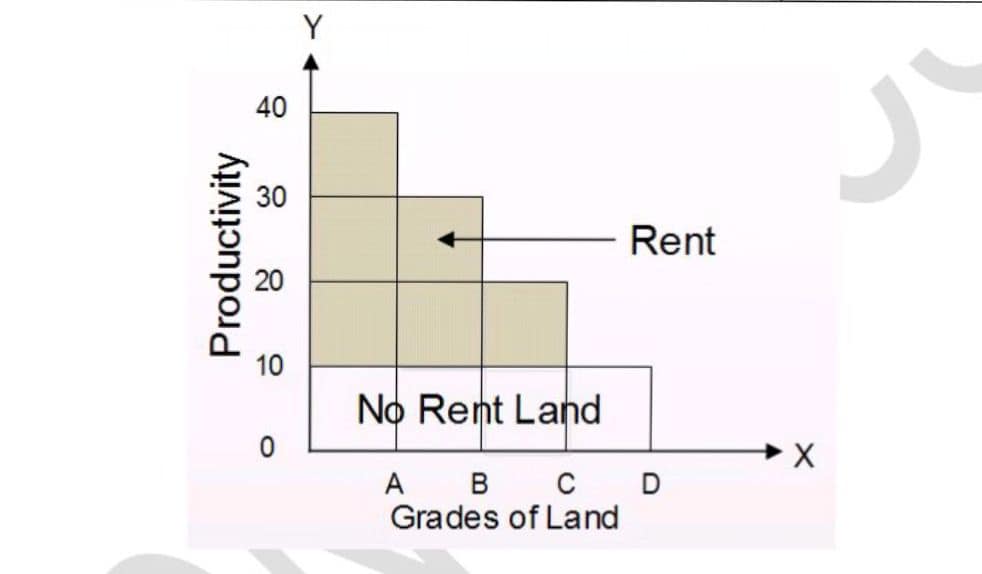
(note: the above numbers of y axis 10,20,30,40 should actually taken as 20 ,40, 60,80.)
Land D is the marginal land or no rent land. Excess of the portion over the produce of land D is the rent which is indicated by the shaded portion.
Ricardian theory applies to extensive as well as intensive cultivation of land. Under extensive cultivation more and more land is cultivated to produce more. The above example of four type of land is an example relating to extensive cultivation.
also read: explain the marginal productivity theory of distribution.

- Explain the cash balance theory of money. - July 7, 2026
- MAJOR-ECONOMICS-2 MONEY BANKING AND INTERNATIONAL TRADE. - July 6, 2026
- MAJOR- ECONOMICS-MACRO ECONOMICS - June 27, 2026
Discover more from EcoLaw
Subscribe to get the latest posts sent to your email.