
Multiplier meaning:
The multiplier refers to the effect of changes in investment outlays on aggregate income through induced consumption expenditure. Thus the multiplier express a relationship between an initial increment of investment and the resulting increase in aggregate income. Infact the multiplier is the name given to the numerical co- efficient which indicates increase in income which will result in response to an increase in investment.
Multiplier Theory.
Keynes assume that when the real income of the community increases or decreases its consumption will increase or decreases but not in the same proportion hence the marginal propensity to consume is always less than 1. This conception of the marginal propensity to consume is at the heart of the multiplier principle. the value of the multiplier is in fact determined by the marginal propensity to consume. the larger value the greater is the value of the multiplier and vice Versa. Thus the investment multiplier is a direct function of the marginal propensity to consume on the basis, Keynes sets a general formula for the multiplier as follows.
Multiplier formula.
K=1 or 1
1= (delta C/delta Y) or 1-MPC
Where K stand for the multiplier coefficient and delta C delta Y refers to the marginal propensity to consume.
Alternatively, since 1- MPC=MPS we can say
K=1/MPS
Where MPS refers to the marginal propensity to save..
This means that a multiplier coefficient is measured as the reciprocal of the marginal propensity to save..
theoretically the values of the multiplier have a wide range from 1 to infinite where MPC = 0, K=1 and when MPC = 1,K=a ,a result which may prove explosive but how your both this cases are a rare phenomena because in a normal circumstances the marginal propensity to consume is always less than 1 and cannot be zero. Keynes estimate the actual value of the multiplier to be about 3 with variation in different phases of the trade cycle.
Multiplier Graphical representation.
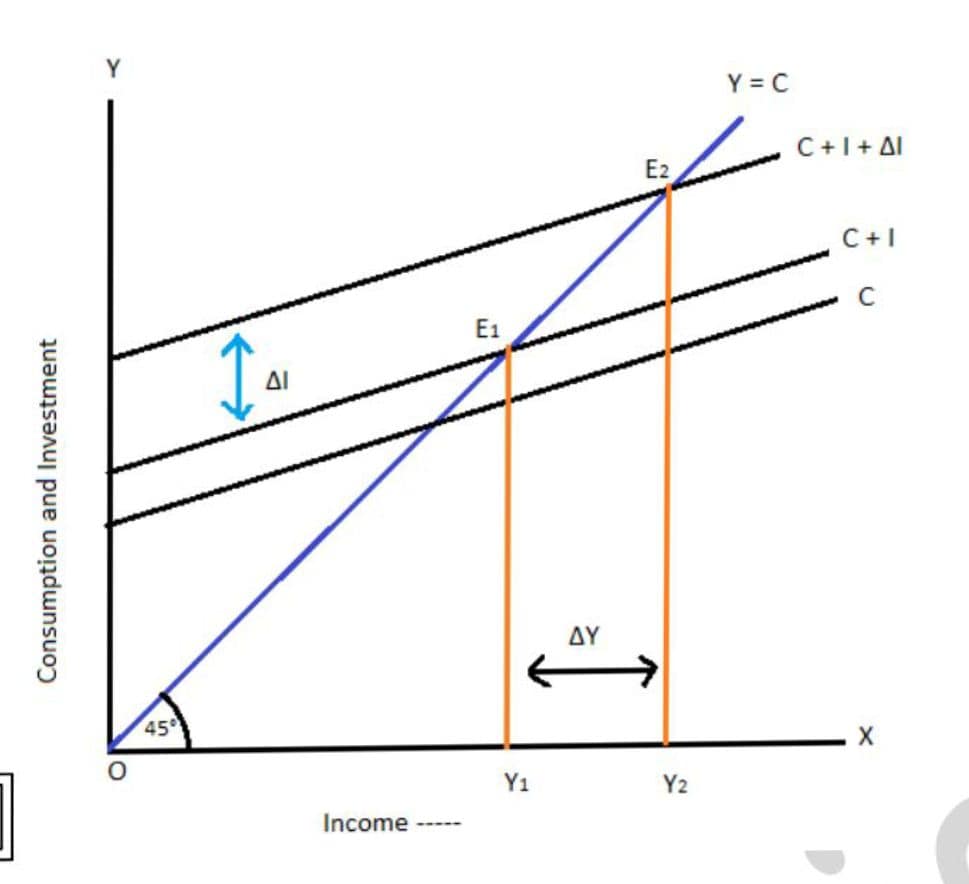
Here are the main aspects of the Keynesian multiplier theory:
- Basic Concept:
- The multiplier effect occurs when an initial increase in spending (such as investment, government expenditure, or consumer spending) leads to a series of subsequent increases in income and consumption, thereby magnifying the initial economic impact.
- The concept is based on the idea that one person’s spending becomes another person’s income, which in turn leads to more spending and income in a continuous cycle.
- Process of Multiplier Effect:
- Initial Spending Increase: An initial increase in spending, such as a government investment in infrastructure.
- Income Generation: This spending creates income for workers and suppliers involved in the project.
- Subsequent Spending: These workers and suppliers then spend their income on goods and services.
- Repeated Cycles: The recipients of this subsequent spending also spend their income, and the process continues.
- Impact on Aggregate Demand:
- The multiplier effect increases aggregate demand, which can lead to higher production, employment, and income levels in the economy.
- It is particularly significant in addressing periods of economic recession or depression, where stimulating aggregate demand can help in recovery.
also read: Explain the Keynesian Theory of Employment? Explain Keynes’s Principle of Effective Demand.

- Explain the cash balance theory of money. - July 7, 2026
- MAJOR-ECONOMICS-2 MONEY BANKING AND INTERNATIONAL TRADE. - July 6, 2026
- MAJOR- ECONOMICS-MACRO ECONOMICS - June 27, 2026
Discover more from EcoLaw
Subscribe to get the latest posts sent to your email.