Every factory that generates dust, fumes, gases or vapours has to answer one practical question sooner or later: what equipment will keep emissions within the limits the law allows. That question has an engineering answer and a legal answer, and the two are connected. This guide explains both — what air pollution control equipment does, the main types used in Indian factories, and how equipment choices tie back to the Air Act, the Environment (Protection) Rules, and a unit’s Consent to Establish or Consent to Operate.
The article also covers the 2025–2026 changes to the consent framework, since several factories are still working off older assumptions about what consent and exemption rules require.
Table of Contents
What Is Air Pollution Control Equipment?
Air pollution control equipment is the general term for engineered systems installed at an industrial facility to capture, remove, convert or otherwise reduce pollutants before they are released into the atmosphere. It covers a wide range of technologies — some designed to trap solid particles, others to absorb or convert gases, and others to destroy organic vapours through heat or catalysis.
It’s useful to separate this from pollution-monitoring equipment, such as continuous emission monitoring systems (CEMS) or ambient air quality monitors. Control equipment changes what actually leaves the stack or the shop floor. Monitoring equipment measures what is being emitted. A factory can have excellent monitoring and poor control, or good control equipment with no monitoring at all — the law increasingly expects both, but they serve different functions and often sit under different compliance conditions.
Selection of equipment is not generic. A foundry generating fine metallic dust needs a very different system from a chemical unit releasing acidic gas, even though both fall under the same broad label of “air pollution control equipment.”
Why Air Pollution Control Equipment Matters for Factory Compliance
Industrial processes — combustion, grinding, crushing, chemical reactions, drying, coating, welding — generate emissions as a natural by-product. Left uncontrolled, these emissions can exceed the standards a factory is legally required to meet, expose workers and neighbouring communities to harmful pollutants, and trigger enforcement action ranging from directions to shut down operations to financial penalties.
The connection between equipment and compliance runs in a specific order:
- An applicable emission standard or consent condition sets the limit for a pollutant from a particular source.
- The factory assesses its actual emissions against that limit.
- Equipment is selected, sized and operated to bring emissions within the limit.
Equipment is the means to an end — meeting the standard — not an end in itself. A factory that buys equipment without first understanding the applicable standard risks installing something oversized, undersized, or simply unsuited to its actual pollutant profile.
Also Read: EPR Registration for Plastic Waste in India: Business Compliance Guide (2026)
Main Types of Air Pollution Control Equipment
The following technologies cover most of what Indian factories install. Each is suited to particular pollutants and process conditions, and none of them is universally “the” solution for a given industry.
Cyclone Separators
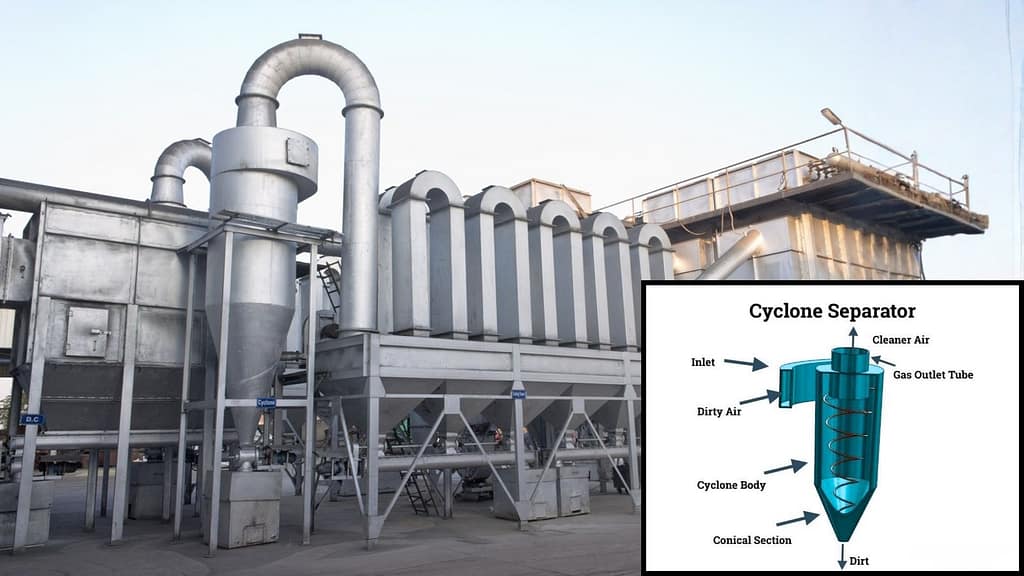
Cyclones use centrifugal force to spin dust-laden air, throwing coarser particles outward against the cyclone wall where they fall into a collection hopper. They are simple, low-cost and low-maintenance, and are commonly used as a pre-collector ahead of a finer filtration stage in material-handling and mineral-processing operations. Cyclones are generally less effective on very fine particulate matter, which is why they are rarely relied on as the sole control device where fine PM is a concern.
Bag Filters / Baghouse Filters
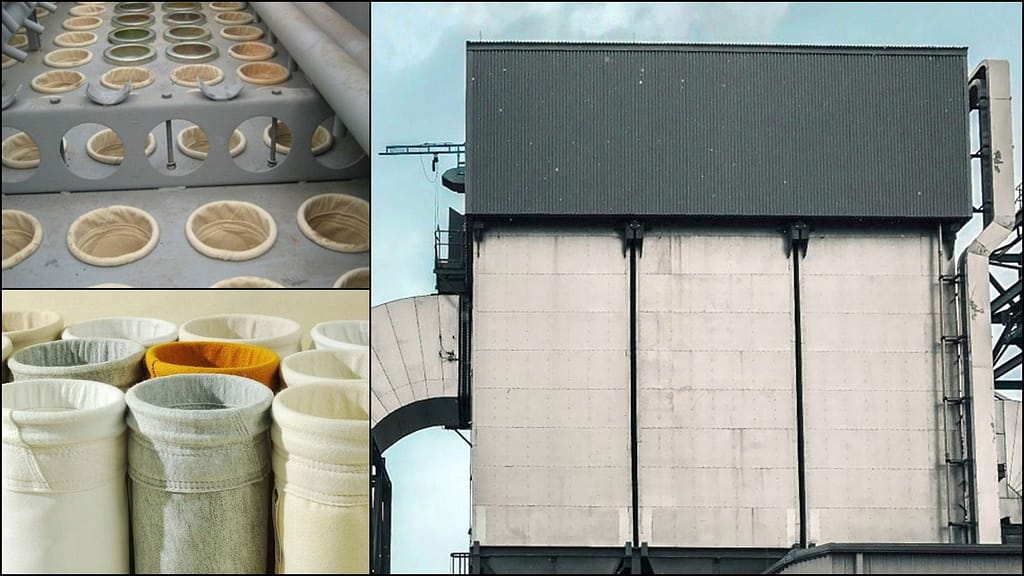
Bag filters pass dust-laden gas through fabric bags that trap particulate matter while allowing cleaned air to pass through. They are widely used in cement plants, foundries, metal processing and general manufacturing because they can achieve high collection efficiency on fine particulate matter. Performance depends heavily on bag material, operating temperature and moisture — a bag rated for one gas stream can degrade quickly if used outside its design conditions.
Electrostatic Precipitators (ESPs)
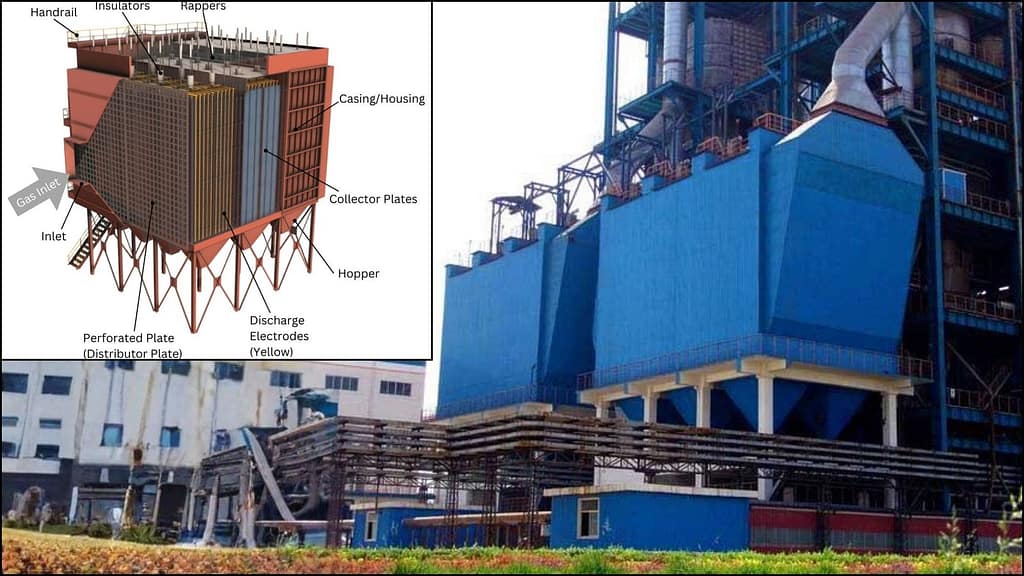
ESPs charge particles electrically and then collect them on oppositely charged plates. They are typically used where gas volumes are large, such as in power generation, cement manufacturing and other high-throughput industrial processes. ESP performance is sensitive to the electrical resistivity of the dust and to the condition of the electrical and control systems, which is why ESPs that appear installed correctly can still under-perform if maintenance is neglected.
Wet Scrubbers
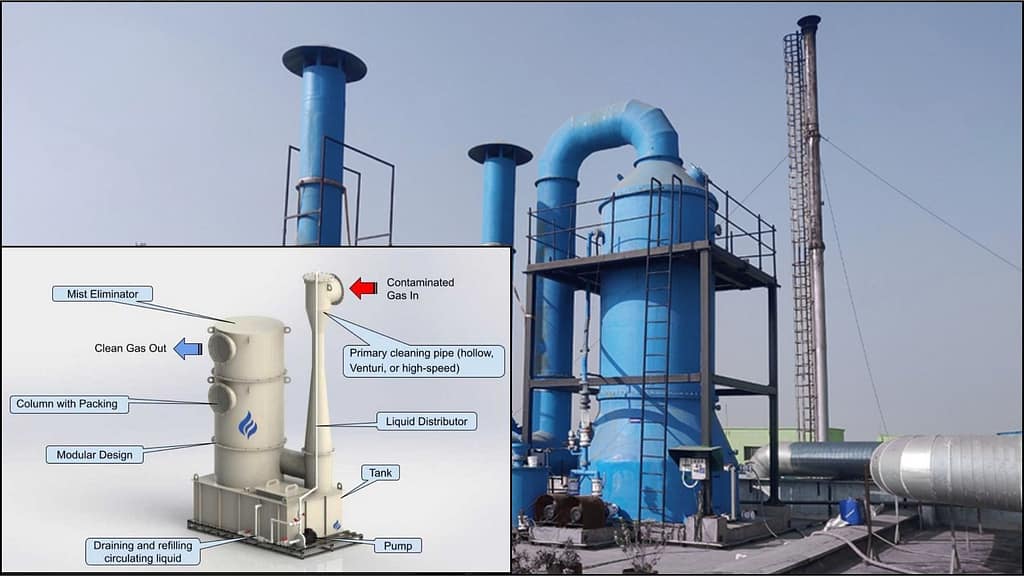
Wet scrubbers bring a gas stream into contact with a liquid, typically water or a chemical solution, to remove particulate matter and soluble or acid gases. They are common in chemical and process industries handling gases such as ammonia, chlorine or acidic vapours. Scrubbers generate wastewater or sludge that itself needs proper handling and disposal, which is an important operating cost and compliance factor often overlooked at the selection stage.
Dry Scrubbers and Adsorption Systems
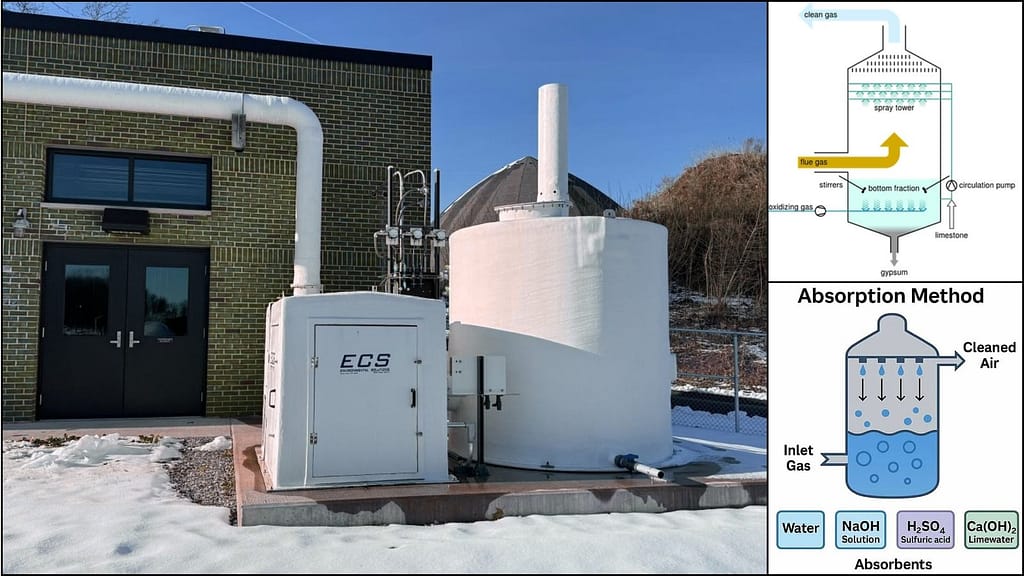
These systems use a dry sorbent, such as activated carbon or a reagent, to adsorb or react with target gases without generating liquid effluent. They are used where acid gases or VOCs need to be controlled but liquid discharge is undesirable. Sorbent selection, replacement frequency and disposal of spent sorbent are the main practical considerations.
Fume Extraction Systems
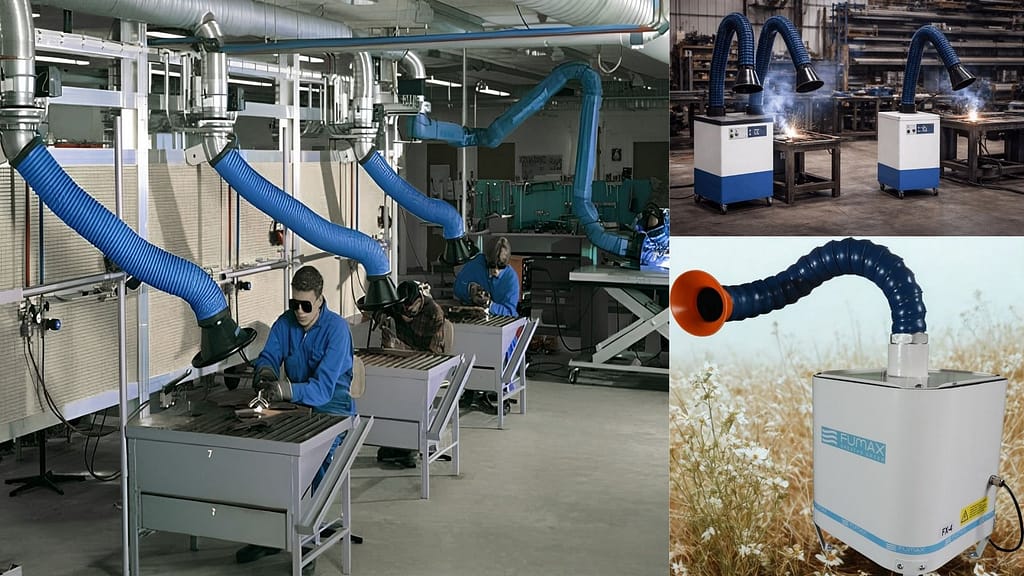
Fume extraction relies on hoods, ducting and fans to capture fumes at or near their source — furnaces, welding stations, metal-processing lines — before they can disperse into the workplace or escape as fugitive emissions. Capture efficiency at the source is critical; a fume extraction system with a badly positioned hood will leave much of the pollutant uncaptured no matter how good the downstream filtration is.
Thermal and Catalytic Oxidisers
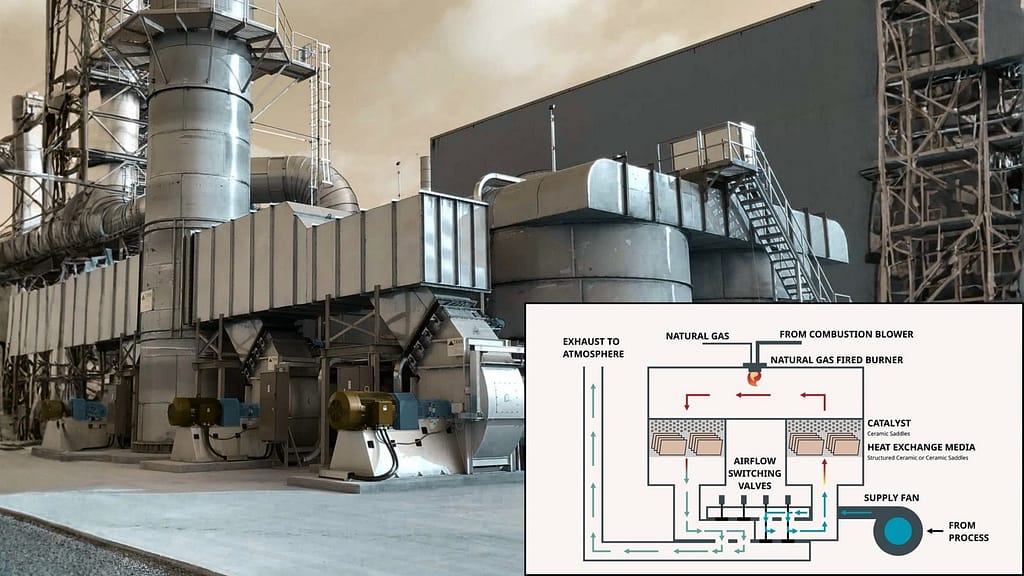
Oxidisers destroy volatile organic compounds and other combustible pollutants by heating them to a temperature at which they break down into carbon dioxide and water, either through direct combustion (thermal oxidation) or with the help of a catalyst that allows the reaction to occur at lower temperatures (catalytic oxidation). These are typically used in coating, printing, chemical and similar VOC-generating processes. Fuel consumption and operating temperature are significant factors in both performance and running cost.
Flue Gas Desulfurization (FGD)
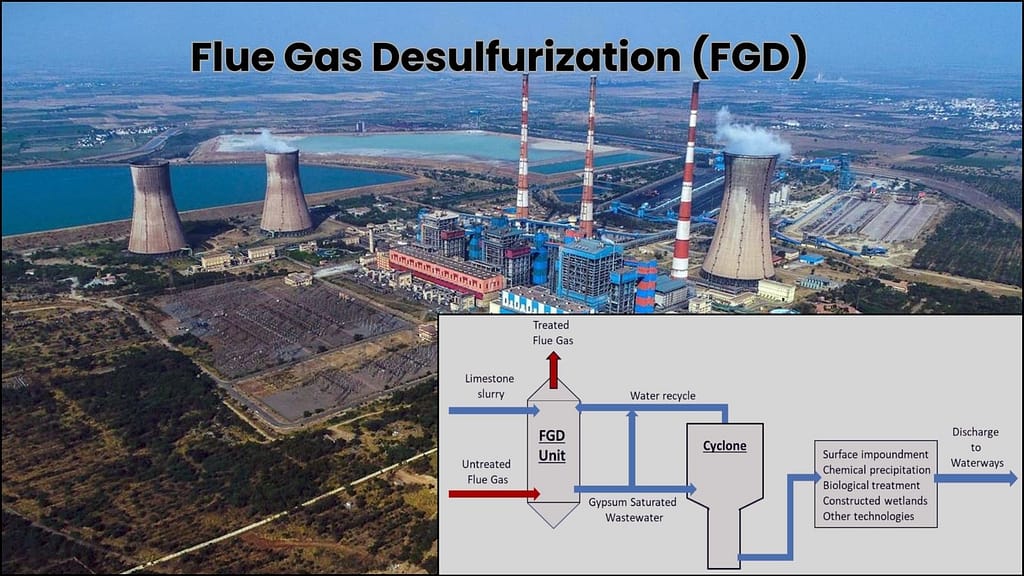
FGD systems remove sulphur dioxide from flue gas, typically using a reagent such as limestone in a wet or dry process. FGD is associated mainly with combustion sources burning sulphur-bearing fuels. It generates a by-product — commonly gypsum in wet limestone systems — that requires proper management.
NOx Control Systems
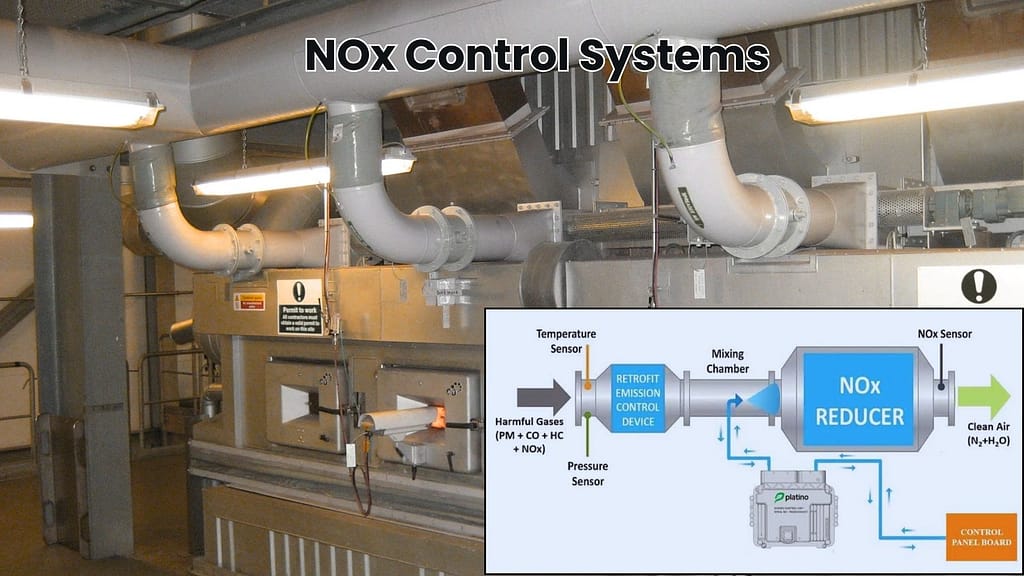
Nitrogen oxide control is achieved through a combination of combustion modifications and after-treatment systems such as Selective Catalytic Reduction (SCR) or Selective Non-Catalytic Reduction (SNCR), which use a reagent to convert NOx into nitrogen and water. These systems are generally associated with combustion sources and depend heavily on process conditions, reagent supply and, for SCR, catalyst condition.
Hybrid and Multi-Stage Systems
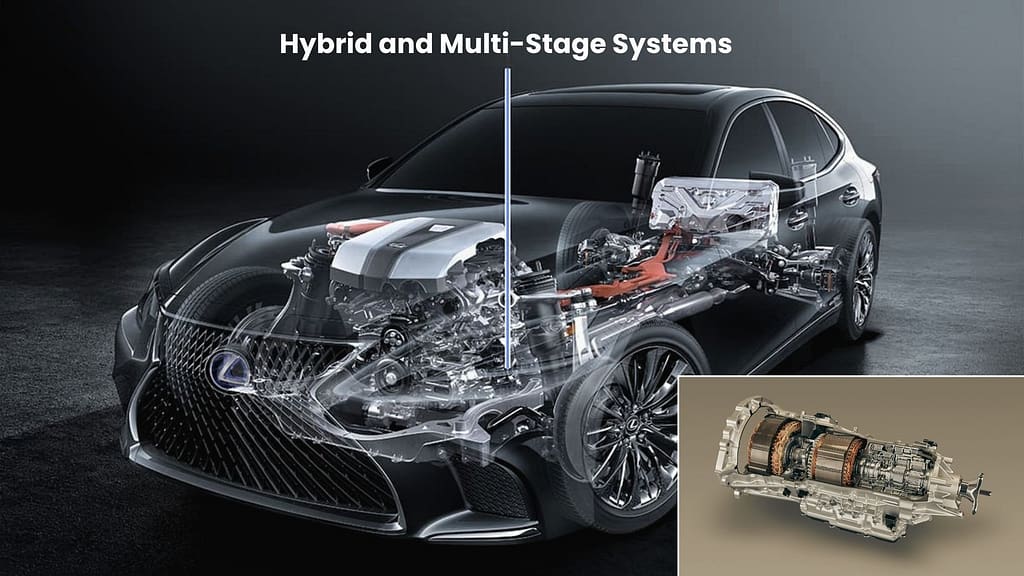
Many industrial processes generate more than one pollutant type simultaneously — for example, particulate matter along with acid gases. In such cases, factories often use a combination of technologies in sequence, such as a cyclone pre-collector followed by a bag filter, or a bag filter followed by a scrubber. The right combination depends on the pollutant mix, not on a fixed industry template.
Which Air Pollution Control Equipment Controls Which Pollutant?
| Pollutant / Problem | Common Equipment | Typical Application | Key Consideration |
|---|---|---|---|
| Coarse particulate matter | Cyclone / mechanical collector | Material handling, mineral processing | Not sufficient alone for very fine particles |
| Fine particulate matter | Bag filter, ESP | Cement, foundry, metal, general manufacturing | Bag material, temperature and moisture; ESP electrical condition |
| Process fumes at source | Local exhaust / fume extraction | Furnaces, welding, metal processing | Capture at source is the deciding factor |
| Acidic or soluble gases | Wet scrubber | Chemical and process industries | Generates wastewater/sludge needing disposal |
| Acid gases / VOCs (dry route) | Dry scrubber / adsorption | Process industries avoiding liquid discharge | Sorbent life and disposal |
| VOCs / organic vapours | Thermal or catalytic oxidiser | Coating, printing, chemical processes | Fuel/energy use and operating temperature |
| SO₂ | FGD | Combustion sources | Reagent supply and by-product management |
| NOx | SCR / SNCR, combustion modification | Combustion sources | Reagent/catalyst condition and process parameters |
| Multiple pollutants | Hybrid / multi-stage systems | Complex industrial processes | Sequencing must match actual pollutant profile |
This table is a general engineering reference, not a compliance checklist. The equipment actually required for a specific factory depends on its applicable emission standard and consent conditions, discussed below.
Air Pollution Control Equipment Requirements Under Indian Law
Air (Prevention and Control of Pollution) Act, 1981
The Air Act is the primary statute governing the prevention, control and abatement of air pollution in India, and it places the State Pollution Control Boards at the centre of implementation.
Section 21 restricts the establishment or operation of an industrial plant in a declared air pollution control area without the previous consent of the State Board. The provision allows the Board to grant consent subject to conditions, which may include requirements to install specified pollution-control equipment, maintain it in good working condition, and make modifications as directed by the Board. In practical terms, this provides the legal basis for a Board’s Consent to Establish (CTE) or Consent to Operate (CTO) to require particular pollution-control systems for a specific industrial unit, rather than the Act itself prescribing a particular device for every industry.
Section 22 prohibits a person operating an industrial plant in an air pollution control area from discharging or permitting the discharge of any air pollutant in excess of the standards laid down by the State Board. This is the core compliance obligation: the law requires the prescribed emission standards to be met; it does not generally mandate one particular type of equipment for every factory.
Two developments have materially changed how Sections 21 and 22 operate in recent years, and both should be considered before relying on older explanations of the Act:
- The Jan Vishwas (Amendment of Provisions) Act, 2023, which brought the relevant amendments to the Air Act into force from 1 April 2024, substituted Section 21(1). The amended provision prohibits establishing or operating an industrial plant in an air pollution control area without previous consent obtained through an application made under the section. It also introduced Section 21A, which empowers the Central Government to issue guidelines, in consultation with the CPCB, concerning the grant, refusal or cancellation of consent, including mechanisms for time-bound disposal of applications. The amendment also replaced the older criminal penalty provisions under Sections 37–40 with an administrative penalty framework. As a result, many contraventions that previously carried the possibility of imprisonment are now primarily dealt with through monetary penalties determined by an adjudicating officer. Imprisonment remains relevant in specified circumstances, including operating without the required consent or failing to pay an imposed penalty.
- Central Government notifications issued under the amended Act have exempted specified categories of industries, notably certain White Category units, from the consent requirement. In some circumstances, the regulatory framework may also interact with conditions attached to environmental clearance where applicable. This represents an important change from the earlier position and means that the blanket statement that “every factory needs CTE/CTO” is no longer accurate without checking the applicable category and the current exemption notifications.
Environment (Protection) Act, 1986
Section 7 of this Act prohibits any person carrying on an industry, operation or process from discharging or emitting environmental pollutants in excess of prescribed standards, and the Act gives the Central Government the power to prescribe environmental and emission standards generally. Amendments made through the Jan Vishwas Act, 2023 have similarly moved several penalty provisions under this Act toward an administrative, adjudicating-officer model rather than criminal prosecution for every contravention, though imprisonment is retained for the more serious offences.
Environment (Protection) Rules, 1986
Rule 3 of the EP Rules specifies that emission and discharge standards for industries, operations and processes are set out in the relevant schedules to the Rules, and it permits the CPCB or a State Board to prescribe more stringent standards for a specific industry or process where the circumstances or the receiving environment warrant it. This is the legal basis for the point emphasised throughout this article: there is no single PM, SO₂, NOx or VOC limit that applies uniformly to every factory in India. The applicable schedule depends on the industry sector and, in many cases, the plant’s capacity or product category.
Role of CPCB and State Pollution Control Boards
The CPCB sets national baseline standards and technical guidance, coordinates with State Boards, and issues guidance documents such as those on continuous emission monitoring. State Pollution Control Boards implement the Act at the state level — granting or refusing consent, inspecting plants, prescribing conditions, and taking enforcement action for non-compliance. Because SPCBs can impose more stringent conditions and additional requirements through consent orders and directions, the practical compliance obligations for a given factory often go beyond the bare text of the central Rules.
Consent to Establish and Consent to Operate
CTE is generally sought before a plant is constructed, and CTO before it begins or continues operation. Historically, industrial units across most categories needed both consents under the Air Act (and the corresponding consents under the Water Act), but this position has shifted:
- Recent notifications have exempted certain categories, particularly White Category industries considered to have negligible pollution potential, from the CTE/CTO requirement altogether, in some states merging any residual requirement into environmental clearance conditions.
- The Control of Air Pollution (Grant, Refusal or Cancellation of Consent) Guidelines, 2025, and their 2026 amendment, revised procedural aspects of the consent process — including validity periods, fee structures, and the introduction of a Registered Environment Auditor role that can support verification and inspection alongside State Board officers.
Because these changes affect which industries need consent at all, and what conditions attach to it, a factory should confirm its current category and the applicable consent requirement with its State Pollution Control Board before assuming an older article’s description of the process still applies.
Table — Legal Framework at a Glance
| Law / Instrument | Relevance to Equipment |
|---|---|
| Air Act, 1981 (as amended) | Consent framework, restrictions on industrial plants, emission-standard compliance |
| Environment (Protection) Act, 1986 | Central power to prescribe standards; general prohibition on excess emissions |
| Environment (Protection) Rules, 1986 | Source/industry-specific emission and discharge standards in schedules |
| Consent to Establish / Consent to Operate | Site- and industry-specific conditions, which may specify particular equipment or performance |
| Environmental Clearance conditions, where applicable | Project-specific safeguards, which can include APC, CEMS and monitoring requirements |
| CPCB / SPCB guidelines and directions | Technical standards, monitoring guidance, inspection and enforcement |
Are Factories Legally Required to Install Specific Pollution-Control Equipment?
Generally, no single piece of equipment is mandated by name for every factory. What the law actually requires is compliance with an applicable emission standard, and – where a consent has been granted – with the specific conditions attached to that consent. The equipment is the factory’s chosen means of meeting that standard, and different equipment can achieve the same compliance outcome depending on the process.
That said, this does not mean equipment choice is left entirely to a factory’s discretion in every case. A Consent to Establish or Consent to Operate order can specify particular control systems, performance parameters or monitoring requirements as a condition of the consent. Environmental clearance conditions, where a project falls under the EIA framework, can similarly mandate particular air pollution control, CEMS or ambient monitoring arrangements. Where such a condition exists, it is binding for that specific unit even though it is not a general statutory requirement applicable to all factories.
The categories worth keeping separate, because they carry different legal weight:
- Statutory requirement — set out directly in the Act, Rules or schedules (for example, the general prohibition on exceeding prescribed emission standards).
- Consent condition — imposed on a specific unit through its CTE/CTO, which can be more prescriptive than the general standard.
- Environmental clearance condition — imposed on a specific project under the EIA framework, where applicable.
- Technical/engineering recommendation — a consultant’s or manufacturer’s suggestion of what equipment would help meet the standard.
- Industry practice — what is commonly installed in comparable facilities, which is useful context but not itself a legal requirement.
A factory should verify which of these categories a particular claim falls into before treating it as a compliance obligation.
Also Read: Burger King Pune Trademark Battle: Passing Off vs Infringement
How Emission Standards Determine Equipment Selection
The logical sequence for a factory assessing its equipment needs generally runs:
- Identify the applicable emission standard for the relevant source — this depends on the industry sector, and sometimes on capacity or fuel type, under the schedules to the Environment (Protection) Rules, 1986, or on any more stringent standard the CPCB or SPCB has prescribed.
- Identify consent conditions or EC conditions, if any, that apply specifically to the unit.
- Characterise the actual emissions — pollutant type, concentration, gas flow, temperature and moisture — from the source in question.
- Select equipment capable of bringing those emissions within the applicable limit, with an appropriate operating margin.
This applies whether the pollutant of concern is particulate matter (often expressed as PM or, for ambient contexts, PM10/PM2.5), SO₂, NOx, VOCs, acid gases or process-specific fumes. Because the applicable numerical limit genuinely varies by industry, capacity category and sometimes location, this article does not quote a single PM, SO₂ or NOx figure as a universal limit — any factory needing the exact applicable number should check the relevant schedule to the EP Rules or its own consent order, since using an outdated or wrong-industry figure is one of the more common compliance mistakes.
How to Choose Air Pollution Control Equipment for a Factory
A structured selection process reduces the risk of installing equipment that is the wrong size, the wrong technology, or non-compliant despite a genuine investment.
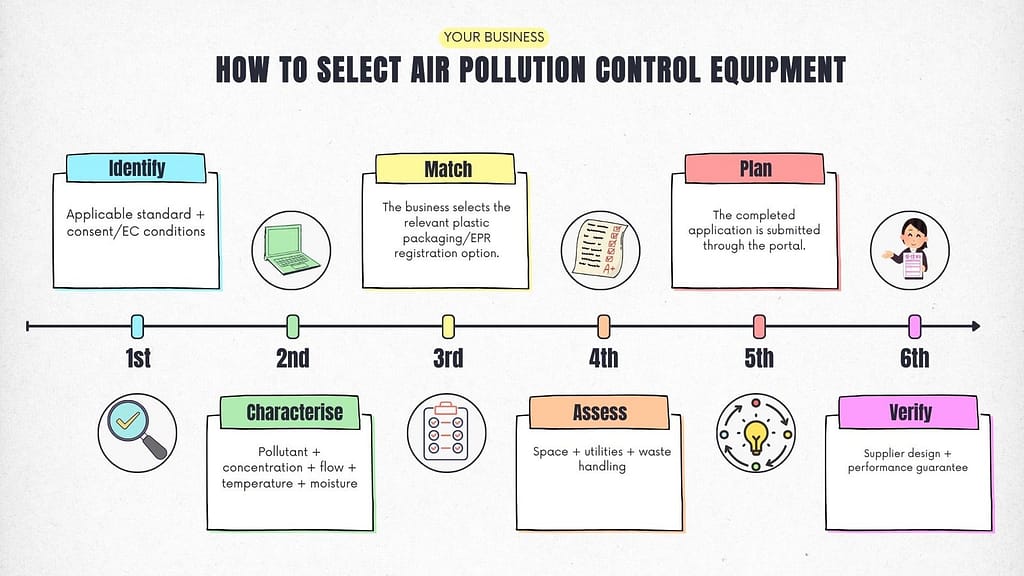
Step 1: Identify the Applicable Standard and Consent Conditions
Establish the emission standard that applies to the specific source, and check whether the factory’s CTE/CTO or EC already specifies particular equipment, performance levels or monitoring requirements.
Step 2: Characterise the Emission Source
Measure or estimate the pollutant type, concentration, gas flow rate, temperature, moisture content and particle size distribution. These parameters determine which technologies are even technically suitable.
Step 3: Match Technology to Pollutant and Process Conditions
Use the pollutant-to-equipment relationships described earlier as a starting point, but confirm suitability against the actual process conditions — a bag filter design suited to a dry, cool gas stream may not perform the same way on a hot, moist one.
Step 4: Assess Site, Utility and Waste-Handling Requirements
Consider space for the equipment and ducting, power availability, water or reagent supply for wet systems, and how any resulting waste — sludge, spent sorbent, gypsum — will be handled and disposed of.
Step 5: Plan for Maintenance and Monitoring from the Outset
Build in a maintenance schedule, spare-parts availability, and the monitoring arrangement (manual stack testing, CEMS, or both) needed to demonstrate ongoing compliance, rather than treating monitoring as an afterthought once equipment is installed.
Step 6: Verify Before Finalising a Supplier
Confirm the supplier’s proposed system is actually designed for the measured or estimated emission parameters, not a generic industry template, and request performance guarantees tied to the applicable standard rather than general claims of efficiency.
Air Pollution Control Equipment Cost in India
Search demand for “air pollution control equipment price” is high, but a single figure would be misleading. Current marketplace listings for pollution-control equipment show a very wide price range — from relatively low-cost basic units to systems priced well into the lakhs – depending on capacity, technology and specification. Rather than quoting one number, it is more useful to understand what actually drives cost:
- Technology type — a simple cyclone is generally far less expensive than an ESP or a multi-stage hybrid system.
- Gas flow capacity — larger volumes require larger, more expensive equipment.
- Materials of construction — corrosion-resistant materials for acid-gas applications cost more than standard construction.
- Automation and control systems, particularly for ESPs and oxidisers.
- Installation, ducting and civil work, which can be a substantial share of total project cost.
- Ongoing operating costs — fuel for oxidisers, reagent for scrubbers/FGD/SCR, replacement bags or sorbent, and electricity.
- Monitoring equipment, where CEMS or stack-testing arrangements are required in addition to the control system itself.
A government-prescribed “equipment fee” does not generally exist as such; what exists are consent-related fees under the Air Act framework (which are separate from equipment procurement cost) and the market cost of the equipment itself, which varies by supplier. Any specific supplier quotation should be treated as a commercial figure, not a regulatory benchmark, and factories evaluating suppliers should look at design calculations, references, and after-sales maintenance support rather than price alone.
Practical Examples
Example 1: A Dust-Generating Manufacturing Unit
A unit that crushes, grinds and transfers raw material generates substantial dust at several points along the process. A typical approach would combine source capture – enclosures and hoods at the crushing and transfer points – with ducting to a cyclone pre-collector for coarse material, followed by a bag filter for finer dust, and a properly designed stack. Fugitive dust from open storage or uncaptured transfer points would also need to be addressed separately, since a well-functioning bag filter on one stack does not resolve dust escaping elsewhere on site. Whether a bag filter specifically is required, as opposed to some other combination, depends on the applicable standard and the unit’s consent conditions – it should not be assumed simply because it is common in similar facilities.
Example 2: A Chemical Manufacturing Unit
A process generating acidic gases might lead an engineer to consider a wet scrubber, but the right choice depends on the specific gas composition, concentration, temperature and solubility, along with practical factors such as reagent availability, corrosion resistance of materials, and the applicable emission limit for that gas. A dry adsorption system might be more appropriate where liquid effluent generation is a concern. The point is that “acidic gas → scrubber” is a starting hypothesis, not a rule, and it needs to be tested against the actual process and standard.
Example 3: A Boiler or Combustion Source
A combustion source burning solid or liquid fuel can require a combination of particulate control, SO₂ control depending on fuel sulphur content and applicable standard, NOx-control measures depending on combustion conditions and applicable limits, an appropriately designed stack, and emission monitoring. There is no single universal equipment configuration for boilers — the combination depends on fuel type, capacity, and the specific standards that apply to that category of combustion source.
Example 4: A Factory With Equipment Installed but Continuing Visible Emissions
A factory can have pollution-control equipment on paper and still show visible emissions or fail a stack test. Common causes include damaged filter bags that no longer capture fine particulate matter, inadequate suction at capture hoods, leaking ducts that allow pollutants to escape before reaching the control device, an overloaded system running beyond its designed capacity, poor or deferred maintenance, and fugitive emissions occurring outside the controlled stack altogether. This example illustrates why installation is not the end point of compliance – ongoing operation, maintenance and monitoring are what actually keep a factory within its permitted limits.
Common Compliance Mistakes Factories Should Avoid
- Installing undersized equipment that cannot handle actual gas flow or pollutant load, often because the system was sized on assumed rather than measured parameters.
- Ignoring fugitive emissions while focusing only on the main stack.
- Treating installation as the end of compliance, without a maintenance and monitoring plan.
- Overlooking specific consent or EC conditions that go beyond the general emission standard.
- Relying on outdated emission limits or an outdated understanding of the consent/exemption framework, particularly given the 2024–2026 changes to Air Act consent guidelines and White Category exemptions.
- Failing to maintain monitoring systems, so that even correctly sized equipment cannot demonstrate compliance when a Board inspects.
- Choosing equipment based mainly on price, without verifying it is actually designed for the factory’s measured emission parameters.
Frequently Asked Questions
It refers to engineered systems — such as bag filters, electrostatic precipitators, scrubbers, oxidisers and similar technologies — used to capture, remove or neutralise pollutants generated by an industrial process before they are released to the atmosphere.
Common types include cyclone separators, bag filters/baghouses, electrostatic precipitators, wet and dry scrubbers, fume extraction systems, thermal and catalytic oxidisers, flue gas desulfurization systems, and NOx-control systems such as SCR or SNCR. Many factories use a combination of these depending on their specific pollutant mix.
Bag filters and electrostatic precipitators are generally the most effective for fine particulate matter, while cyclones are typically used for coarser particles or as a pre-collector ahead of finer filtration. The right choice depends on particle size, gas volume, temperature and moisture, not on a single “best” technology for all situations.
Not in the sense of a specific device being named by statute for every factory. Indian law generally requires compliance with applicable emission standards, and equipment is the means a factory uses to meet those standards. A factory’s Consent to Establish or Consent to Operate, or its environmental clearance conditions where applicable, can specify particular equipment or monitoring requirements for that unit. Some categories of industry, notably certain White Category units, have also been exempted from the underlying consent requirement itself under recent notifications, so applicability should be checked against the factory’s current category rather than assumed.
Requirements are generally determined by the applicable emission standard for the industry/source under the Environment (Protection) Rules, 1986 (or any more stringent standard the CPCB or SPCB has prescribed), together with any conditions attached to the factory’s consent or environmental clearance. The factory’s own process characteristics — pollutant type, concentration, gas flow — then determine what equipment can practically meet that standard.
Approval requirements generally arise through the Consent to Establish/Consent to Operate process administered by the State Pollution Control Board rather than through a separate equipment-approval step, though consent conditions can specify particular equipment, performance levels or monitoring arrangements. Given recent changes to the consent and exemption framework, a factory should confirm its current requirement directly with its SPCB rather than relying on an older description of the process.
Control equipment — filters, scrubbers, oxidisers and similar systems — reduces or removes pollutants before they are emitted. CEMS is monitoring equipment that measures pollutant concentration or mass emission on an ongoing basis. A factory can have control equipment without CEMS, or vice versa, though many larger or higher-category units are required to have both. CEMS applicability depends on the specific sector, source and consent/EC conditions rather than being universal.
Cost varies substantially by technology, capacity, materials and site conditions — current marketplace listings for pollution-control equipment range widely, from basic low-cost units to systems priced in the lakhs. Rather than a single figure, factories should evaluate cost drivers such as gas flow capacity, materials, automation, installation, and ongoing operating costs like fuel, reagent or filter replacement, and treat any specific supplier quotation as commercial rather than regulatory information.
Last Updated: August 2026

Discover more from EcoLaw
Subscribe to get the latest posts sent to your email.