Carbon Removal Credits: Climate change isn’t knocking on the door anymore—it’s inside the house. Floods, wildfires, heatwaves… we see it everywhere. The urgency to act has never been stronger. That’s where carbon removal credits step in.
But here’s the big question: aren’t carbon offsets already solving this?
Not exactly.
There’s a huge difference between avoiding emissions and actually removing carbon from the atmosphere. And that difference is why carbon removal credits are gaining serious attention worldwide.
What Are Carbon Removal Credits?
Basic Definition
Carbon removal credits represent one metric ton of carbon dioxide (CO₂) that has been physically removed from the atmosphere and stored permanently.
Think of it like this:
If pollution is smoke filling a room, carbon removal credits are like installing a powerful vacuum that sucks that smoke out—and locks it away forever.
How They Differ from Traditional Carbon Offsets
Traditional carbon offsets often focus on preventing emissions—like funding renewable energy projects or improving energy efficiency.
Carbon removal credits, on the other hand, do something stronger. They take existing CO₂ out of the air.
Avoidance vs Removal
- Avoidance: Preventing future emissions
- Removal: Cleaning up past emissions
It’s like the difference between not spilling water and mopping up water that’s already on the floor.
How Carbon Removal Credits Work
The Process of Removing CO₂
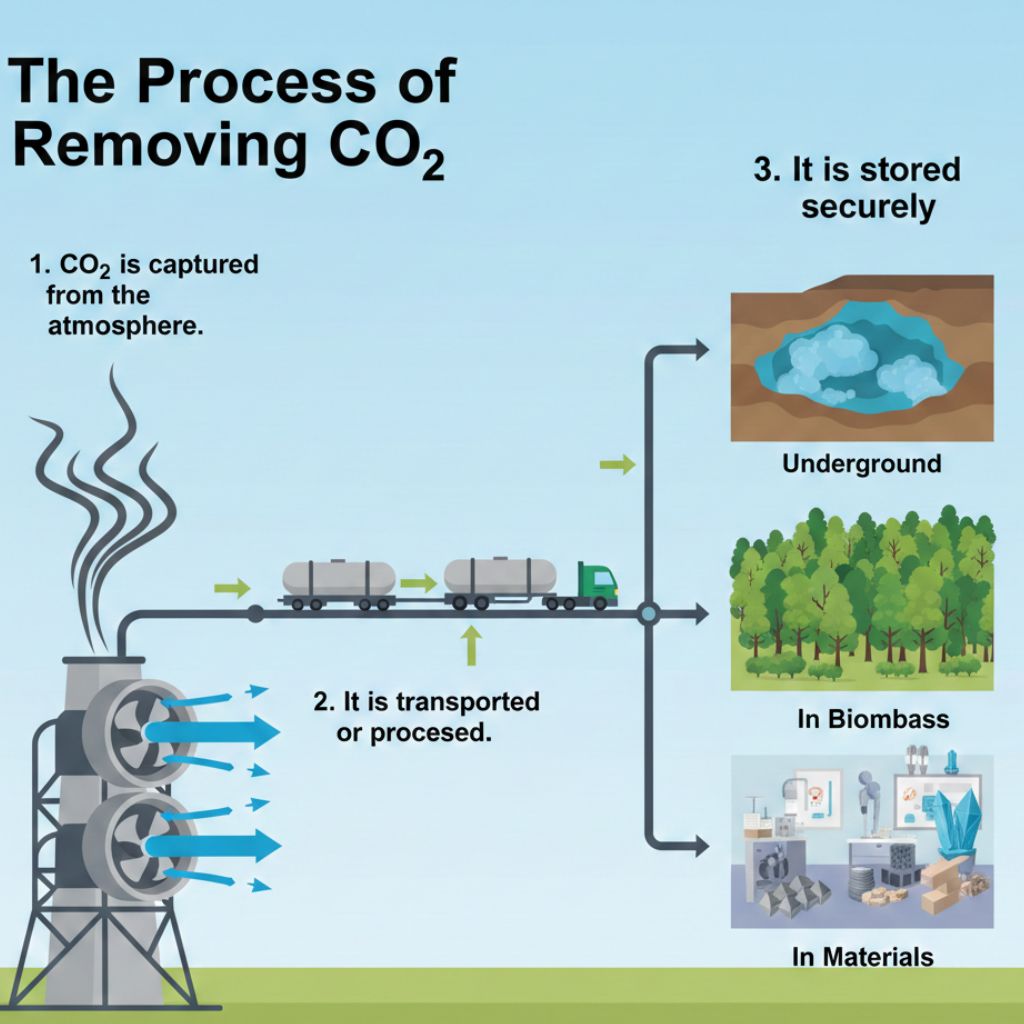
Here’s how it typically works:
- CO₂ is captured from the atmosphere.
- It is transported or processed.
- It is stored securely—either underground, in biomass, or in materials.
Once verified, a carbon removal credit is issued.
Also Read: How to Buy & Sell Carbon Credits Online
Verification and Certification
Credibility matters. Without verification, the system falls apart.
Independent standards ensure:
- The carbon is genuinely removed.
- It is stored permanently.
- There is no double counting.
Role of Independent Standards
Organizations verify projects before credits are sold. Transparency is the backbone of this market.
Types of Carbon Removal Methods
There are two major categories: nature-based and technology-based solutions.
Nature-Based Solutions
These rely on ecosystems.
Reforestation and Afforestation
Planting trees absorbs CO₂ naturally. Forests act like giant carbon sponges.
But here’s the catch—trees can burn or be cut down. Permanence is a concern.
Soil Carbon Sequestration
Farmers adopt regenerative practices that trap carbon in soil. It improves soil health and reduces emissions simultaneously.
Technology-Based Solutions
These are more advanced—and more expensive.
Direct Air Capture (DAC)
Companies like Climeworks use machines that pull CO₂ directly from the air. The captured carbon is stored underground in rock formations.
It’s like a mechanical tree—but far more precise.
Bioenergy with Carbon Capture and Storage (BECCS)
Biomass absorbs CO₂ while growing. It is then used for energy, and the emissions are captured and stored. Net result? Carbon removed.
Why Carbon Removal Credits Are Surging
So why the sudden boom?
Corporate Net-Zero Commitments
Global companies have pledged to hit net-zero emissions by 2050 or sooner. But cutting emissions alone isn’t enough. They need removal to balance unavoidable emissions.
Tech giants and airlines are investing heavily in removal credits.
Investor Pressure and ESG Trends
Environmental, Social, and Governance (ESG) investing is reshaping capital markets. Investors demand measurable climate action.
Carbon removal credits provide tangible proof.
Regulatory Developments
Governments are tightening emission standards. Carbon pricing systems are expanding. Removal credits fit into these evolving frameworks.
Consumer Awareness
Today’s consumers care. Brands that invest in credible climate solutions gain trust and loyalty.
Key Players in the Market
Corporations Buying Credits
Major global firms in technology, aviation, and manufacturing sectors are among early adopters.
Climate Tech Startups
Startups focused on carbon capture are attracting billions in funding.
Carbon Market Platforms
Marketplaces connect buyers and project developers, ensuring transparency and liquidity.
Market Size and Growth Projections
Current Market Valuation
The carbon removal market is still small compared to traditional offsets—but it’s growing rapidly.
Future Growth Forecast
Experts predict the market could reach hundreds of billions of dollars by 2050 as demand skyrockets.
Why? Because reaching global climate targets without removal is nearly impossible.
Pricing of Carbon Removal Credits
Why They Cost More Than Offsets
Traditional offsets may cost $5–$20 per ton.
Carbon removal credits? Often $100–$600 per ton.
Why the premium?
Because technology-based removal is expensive, energy-intensive, and still scaling.
Factors Affecting Prices
- Technology used
- Permanence guarantee
- Verification quality
- Market demand
As technologies scale, prices are expected to decline.
Benefits of Carbon Removal Credits
Long-Term Climate Impact
Removal directly reduces atmospheric CO₂ levels. It addresses historical emissions—not just future ones.
Innovation Acceleration
Buying credits funds research and development. It’s like investing in the climate technologies of tomorrow.
Challenges and Criticism
High Costs
Small businesses may find removal credits unaffordable.
Permanence Concerns
Nature-based solutions risk reversal through fires or land-use change.
Risk of Greenwashing
Companies might rely on removal instead of cutting emissions.
That’s dangerous.
Removal should complement reductions—not replace them.
Carbon Removal vs Carbon Reduction
It’s not either/or.
We must:
- Reduce emissions aggressively.
- Remove unavoidable carbon.
Imagine climate change as a bathtub overflowing.
Reduction turns off the tap.
Removal drains the water.
You need both.
How Businesses Can Participate
Measuring Emissions
First step? Conduct a carbon footprint assessment.
You can’t manage what you don’t measure.
Choosing the Right Credits
Look for:
- Strong verification
- Long-term storage
- Transparent reporting
Quality over quantity always wins.
The Role of Governments
Policy Support
Governments can accelerate adoption through:
- Subsidies
- Tax credits
- Research funding
Carbon Pricing Mechanisms
Carbon taxes and cap-and-trade systems can integrate removal credits into compliance markets.
Policy clarity builds investor confidence.
The Future of Carbon Removal Credits
Scaling Technologies
As innovation improves, costs will fall. Think about solar panels—they were expensive once too.
Integration into Global Climate Strategy
Climate models show that achieving global temperature targets requires billions of tons of carbon removal annually by mid-century.
Carbon removal credits are not a trend. They are becoming a pillar of climate strategy.
Conclusion
Carbon removal credits represent a powerful evolution in climate action. Instead of just slowing emissions, they actively clean up the atmosphere.
Yes, they’re expensive. Yes, there are challenges. But the surge in demand shows something important—businesses, investors, and governments recognize that cutting emissions alone won’t be enough.
If climate change is a debt, carbon removal credits are a way of paying it back.
The real question isn’t whether they matter.
It’s how fast we can scale them.
FAQs
1. Are carbon removal credits better than carbon offsets?
They are more impactful because they remove existing CO₂, but both play important roles in climate strategy.
2. Why are carbon removal credits expensive?
Advanced technologies like Direct Air Capture are costly and still developing, which increases prices.
3. Can individuals buy carbon removal credits?
Yes, some platforms allow individuals to purchase them, though they are primarily used by corporations.
4. Are nature-based carbon removal projects permanent?
Not always. Forest fires or land-use changes can reverse carbon storage, which is why verification matters.
5. Will carbon removal credits become cheaper in the future?
Most experts believe prices will decline as technology scales and investment increases.