
- How to Complete the Copyright Registration Procedure in India for Software and Online Content - August 30, 2026
- Provisional Patent Filing Process in India: Complete Guide to Costs, Forms and Deadlines - August 26, 2026
- Trademark Opposition Rules in India: Timeline & Evidence Filing - August 20, 2026
Quick Summary & Executive Takeaway
The statutory copyright registration procedure in India requires filing Form XIV with the Statement of Particulars through the Copyright Office’s e-filing portal, ipindia.gov.in, along with a government fee ranging from ₹500 for literary, artistic, musical, or dramatic works (which covers software and website content) to ₹5,000 for cinematograph films.
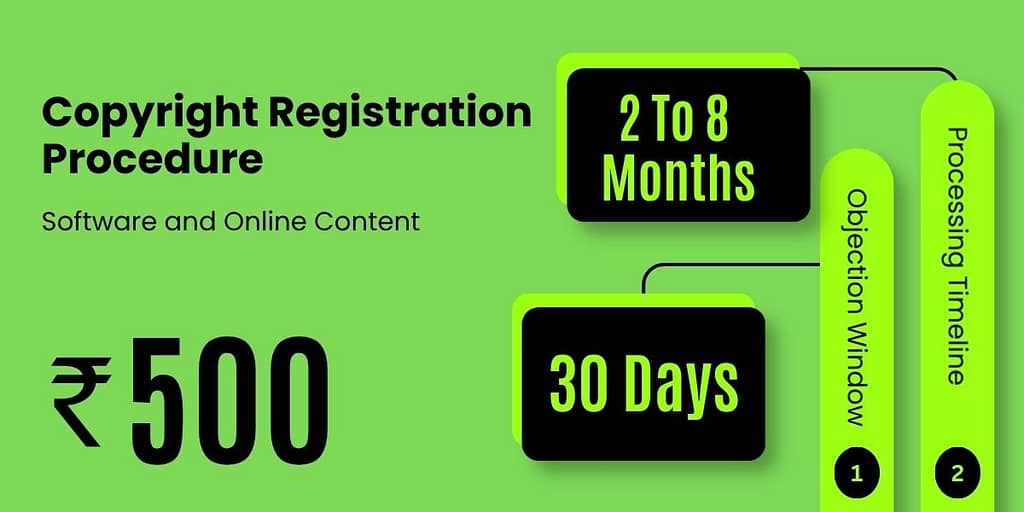
Every application undergoes a mandatory 30-day objection window under the Copyright Act, 1957, before an examiner reviews it and the Registrar issues a certificate. A clean application typically clears in two to eight months from the date a Diary Number is issued.
Table of Contents
Why This Matters Before You Write Code or Publish Content
A software product built over eighteen months, a proprietary training manual, or an original app interface is not automatically defensible the moment a competitor copies it or a departing employee walks off with the repository. Indian courts routinely expect a claimant to produce documentary evidence of ownership before granting an injunction, and an unregistered work leaves a founder or HR head arguing authorship from scratch, mid-dispute.
The copyright registration procedure in India, set out in Chapter X of the Copyright Act, 1957 and Chapter XIII of the Copyright Rules, 2013, and administered by the Copyright Office under the Department for Promotion of Industry and Internal Trade (DPIIT), exists to close exactly that gap. Filed correctly through copyright.gov.in, registration converts an informal claim into an entry in the Register of Copyrights that carries prima facie evidentiary value under Section 48 — useful in an infringement suit, a licensing negotiation, or investor due diligence.
Also Read: How to File a Trademark Objection Reply Online in India
Step-by-Step Copyright Registration Procedure in India
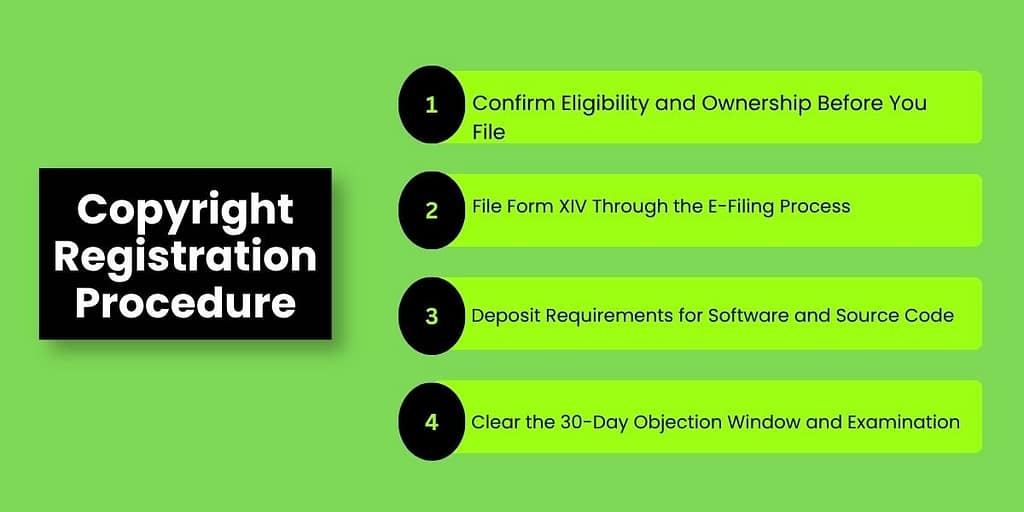
Registering copyright in India means confirming who may apply, filing Form XIV online, depositing a compliant copy of the work, and clearing a mandatory 30-day objection window before the Registrar of Copyrights issues a certificate.
Confirm Eligibility and Ownership Before You File
Section 45 permits the author, the publisher, the owner, or any other person with an interest in the copyright to apply. Where the applicant is not the individual author — for instance, a company whose employee wrote the code — Rule 70(3) requires an original, signed No-Objection Certificate (NOC) from the author, even where the company already owns the work under Section 17 as the employer. For most startups this means every employee and contractor should have signed an IP-assignment clause before a single line of code or a single paragraph of content is created.
File Form XIV Through the E-Filing Process on ipindia.gov.in
How to register copyright online in India comes down to four actions on the portal: create an applicant account; complete Form XIV together with the Statement of Particulars (and the Statement of Further Particulars, where the category requires it); select the correct work category — software and website text are filed as literary work under Section 2(o), which expressly includes computer programmes; and upload one copy of the work, capped at 10 MB. Paying the fee through the e-payment gateway generates a Diary Number immediately, which is the reference used for every subsequent copyright registration status check India applicants need to run.
Deposit Requirements for Software and Source Code
Under Rule 70(5), as amended by G.S.R. 225(E) dated 30 March 2021, a software applicant must upload a single PDF containing the first 10 and last 10 pages of source code — or the complete code where it runs under 20 pages — with no redacted, blacked-out, or removed sections. Strip credentials, API keys, and customer data from the pages before upload; redacting substantive logic, rather than removing secrets that fall outside the deposited pages, is what draws an objection.
Clear the 30-Day Objection Window and Examination
Once filed, the application enters a mandatory 30-day public window under Rule 70(9) and Rule 70(10), during which any interested party may object. An examiner then checks originality and category classification; discrepancies trigger a written query that must be answered within the stated deadline to keep the file alive. On satisfaction, the Registrar enters the particulars in the Register of Copyrights under Section 44 and issues the certificate.
Copyright Registration Fees and Timeline in India
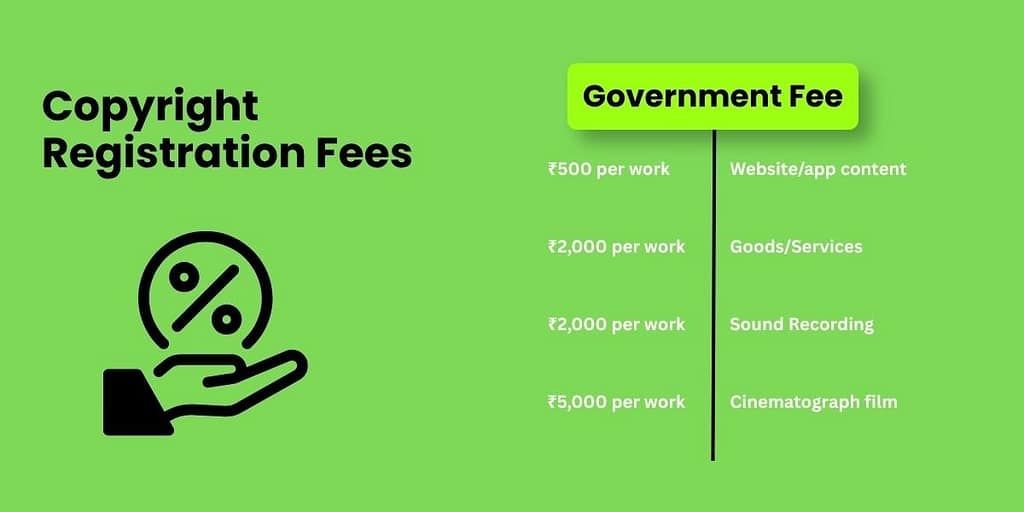
Government fees for the copyright registration procedure in India run from ₹500 to ₹5,000 depending on the category of work, while total turnaround — inclusive of the mandatory objection period — typically runs two to eight months.
| Work Category | Government Fee (Second Schedule, Copyright Rules 2013) | Typical Professional/Legal Fee | Processing Timeline |
|---|---|---|---|
| Literary, dramatic, musical or artistic work — includes software, source code, and website/app content | ₹500 per work | ₹3,000 – ₹15,000 (varies by complexity) | 30-day objection window + 2–6 months to certificate |
| Artistic work used in relation to goods/services (logos, packaging) | ₹2,000 per work, plus Trade Marks Registry search certificate cost | ₹5,000 – ₹20,000 | 2–8 months (extended by search-certificate lead time) |
| Sound recording | ₹2,000 per work | ₹4,000 – ₹15,000 | 2–6 months |
| Cinematograph film | ₹5,000 per work | ₹8,000 – ₹25,000 | 3–8 months |
Government fees are fixed under the Second Schedule to the Copyright Rules, 2013, and apply per work — a company registering its core software, its UI design, and its user manual as three separate works pays three separate fees. The professional-fee figures above are indicative market ranges, not statutory amounts, and vary by firm and case complexity.
No statutory deadline binds the Copyright Office’s examination stage, so the overall timeline is workload-dependent: a clean application with no objection and no discrepancy letter commonly clears within two to three months once the 30-day window closes, while each objection, discrepancy reply, or hearing adds further weeks or months. Businesses that need a certificate ahead of a funding round, an acquisition, or litigation should file well in advance rather than treat registration as same-week paperwork.
Also Read: Trademark Registration Fees in India: Government Cost vs Attorney Fees Explained
Common Pitfalls, Legal Risks, and Rejection Reasons
Most rejections and objection notices in the copyright registration procedure in India trace back to five recurring errors, each avoidable with a short compliance check before filing.
- Redacted or incomplete source code. Blacking out functions, or submitting fewer than the required first-and-last-10 pages under Rule 70(5), is a leading cause of discrepancy letters for software applicants.
- Missing or photocopied NOC. Where the applicant is the owning company rather than the individual author, Rule 70(3) requires an original NOC — a scanned photocopy does not satisfy the rule, and gaps here are common when onboarding paperwork skipped a signed IP-assignment clause.
- Artistic works used in trade filed without a Trade Marks Registry search certificate. The proviso to Section 45(1) requires this certificate for any logo, label, or packaging design capable of use on goods or services; filing without it invites an objection.
- Skipping notice to interested persons. Rule 70(9) requires notifying co-authors, publishers, or assignees before filing; omitting this step routinely resurfaces as a post-filing objection.
- Work that fails the originality threshold. Indian courts apply a “skill and judgment” standard, set out by the Supreme Court in Eastern Book Company v. D.B. Modak (2008) — mere labour or reformatting of existing material, without independent creative contribution, will not sustain a copyright claim on examination or in later litigation.
Software businesses face one additional risk worth flagging separately: an unaudited codebase that embeds copyleft-licensed open-source components can complicate an ownership declaration on Form XIV. Resolve licensing questions during a code audit before filing, not after an objection has already been raised.
Also Read: How to Choose Your Trademark Class: Cross-Class Strategy Secrets for AI, SaaS, and E-Commerce Brands
Copyright Registration Procedure — Document Checklist
Copyright Registration Procedure — Document Checklist (Software & Online Content)
1. Statutory Forms & Work Copies
Phase 1-
Form XIV: Completed Form XIV with Statement of Particulars (and Statement of Further Particulars, if applicable) for the copyright registration procedure.
-
Work Copy: PDF showing first and last 10 pages of unredacted source code for software, or full text for website/written content, under 10 MB.
-
Identity Proof: Applicant identity and address proof.
2. Ownership Declarations & Clearances
Phase 2-
No Objection Certificate: Original, signed NOC from the author, if the applicant is a company or a non-author owner.
-
IP Assignment: Employment or IP-assignment agreement establishing ownership under Section 17, where relevant.
-
Trademark Clearance: Trade Marks Registry search certificate, if the work is an artistic work used in relation to goods/services.
3. E-Filing Fees & Timeline Management
Phase 3-
Statutory Fee: Government fee payment (₹500–₹5,000 depending on category).
-
Status Tracking: Diary Number recorded for status tracking on the official portal.
-
Statutory Window: Calendar reminder for the 30-day objection window and any discrepancy-letter deadline.
Frequently Asked Questions
You need a completed Form XIV with the Statement of Particulars, a copy of the work (for software, the first and last 10 pages of unredacted source code under Rule 70(5)), applicant ID proof, and an original NOC from the author if the applicant is a company or non-author owner. Artistic works used commercially also require a Trade Marks Registry search certificate.
Government fees under the Second Schedule to the Copyright Rules, 2013 range from ₹500 for literary, dramatic, musical, or artistic works (including software) to ₹2,000 for sound recordings and artistic works used in trade, and ₹5,000 for cinematograph films. Professional filing-assistance fees are separate and vary by firm.
No. Copyright protection arises automatically under Section 13 the moment an original work is created and fixed in tangible form. Registration under Section 45 is voluntary, but the Register of Copyrights carries prima facie evidentiary value under Section 48, making ownership far easier to prove in an infringement dispute or licensing negotiation.
There is no statutory deadline. Every application faces a mandatory 30-day objection window first; a clean file with no objections or discrepancy letters typically receives its certificate within two to three months after that, while contested or discrepancy-heavy applications can take six to eight months or longer.
Following each stage of the copyright registration procedure in India in order — eligibility check, Form XIV filing, correct source-code deposit, and the 30-day objection window — is what separates a routine two-to-three-month registration from a file stuck in repeated discrepancy correspondence. For a business registering an entire product suite, that discipline applied once per work is what makes the certificate arrive on schedule.
Discover more from EcoLaw
Subscribe to get the latest posts sent to your email.