
- How to Complete the Copyright Registration Procedure in India for Software and Online Content - August 30, 2026
- Provisional Patent Filing Process in India: Complete Guide to Costs, Forms and Deadlines - August 26, 2026
- Trademark Opposition Rules in India: Timeline & Evidence Filing - August 20, 2026
Quick Summary & Executive Takeaway
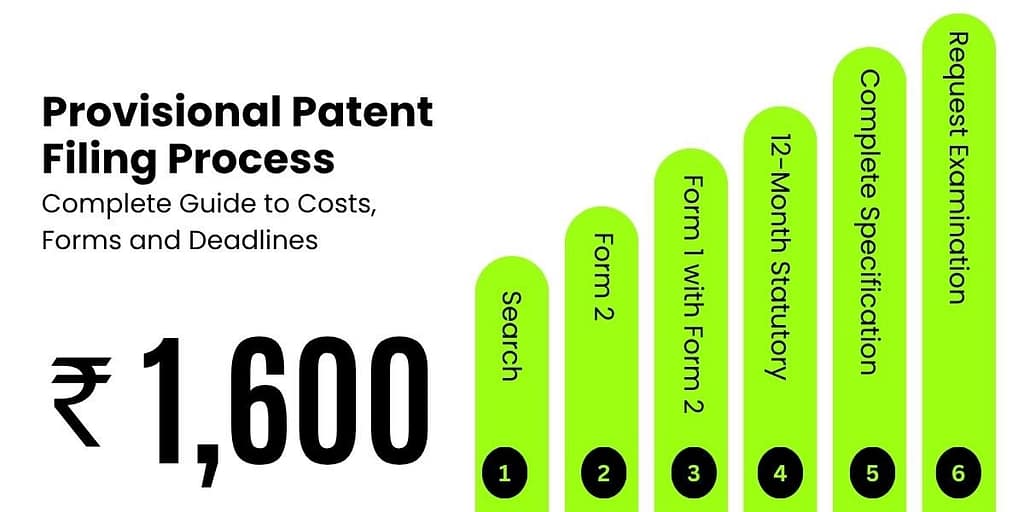
The statutory provisional patent filing process in India lets an applicant secure an early priority date under Section 9 of the Patents Act, 1970, by filing Form 1 with Form 2 for a government fee of ₹1,600 (individuals, startups, small entities, educational institutions) or ₹8,000 (other applicants).
Once filed, the applicant gets a fixed, non-extendable 12-month window to file the complete specification with claims — missing it means the application is treated as abandoned and the priority date is lost. Budget the statutory fee plus ₹8,000–₹25,000 in professional drafting charges for the provisional stage, filed through the Indian Patent Office’s e-filing portal.
Demoing a prototype to a potential investor, publishing a technical paper, or even pitching a distributor before securing a filing date is one of the costliest mistakes a founder can make under Indian patent law — public disclosure without protection can destroy the novelty that Section 2(1)(j) of the Patents Act, 1970 requires for patentability. Small business owners, startup founders, and corporate legal heads who delay filing risk losing patent rights entirely, since India follows an absolute novelty standard with only a narrow 12-month grace period under Section 31 for specific circumstances.
The Indian Patent Office (IPO), functioning under the Controller General of Patents, Designs and Trade Marks (CGPDTM) within the Department for Promotion of Industry and Internal Trade (DPIIT), Ministry of Commerce and Industry, administers this process. Understanding the provisional patent filing process in India before you need it — not after a leak or a rushed demo — is what protects the invention’s commercial value.
Complete Step-by-Step Provisional Patent Filing Process
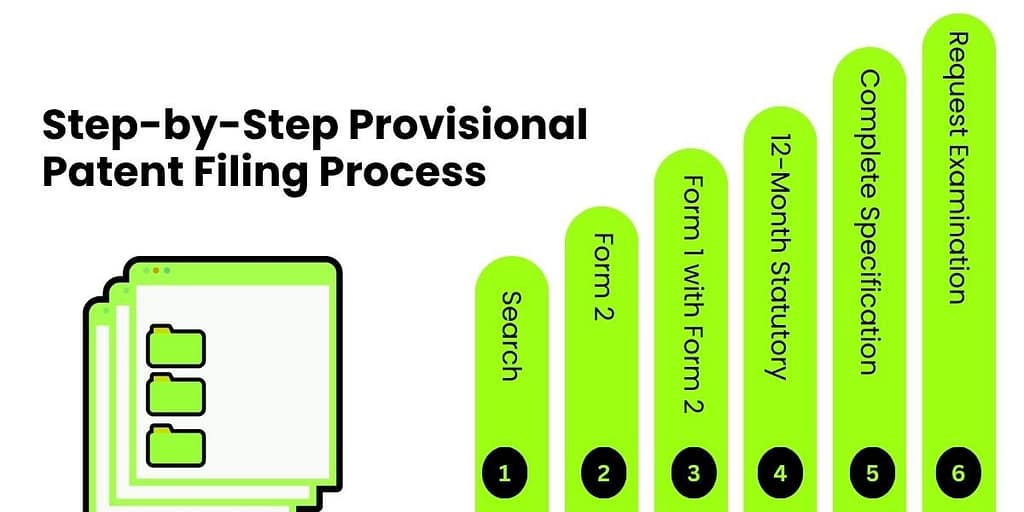
1. Conduct a Patentability Search
- Search prior art on the IP India public search portal, Espacenet, and Google Patents to confirm the invention meets the novelty and inventive-step tests under Sections 2(1)(j) and 2(1)(ja).
- Keep a written record of the search — it supports both drafting decisions and later examination responses.
2. Draft the Provisional Specification (Form 2)
- A provisional specification describes the invention’s core concept; unlike a complete specification, it does not require claims or a final abstract, which is why provisional filing is faster and cheaper.
- Draft broadly enough to cover the invention’s likely development path — anything added later that wasn’t disclosed in the provisional does not get the benefit of the original priority date.
3. File Form 1 with Form 2 on the E-Filing Portal
- File Form 1 (Application for Grant of Patent) together with Form 2 through IP India’s comprehensive e-filing service.
- Pay the government fee at submission: ₹1,600 for a natural person, startup, small entity, or educational institution; ₹8,000 for any other applicant. Physical filing carries a 10% surcharge over the e-filing rate.
4. Track the 12-Month Statutory Deadline
- The filing date becomes the invention’s priority date the moment the office accepts the provisional specification.
- Under Section 9(1), the complete specification — with claims, drawings, and an abstract — must be filed within 12 months. This deadline cannot be extended or condoned; missing it forfeits the priority date permanently.
5. File the Complete Specification
- File a fresh Form 2, this time marked “complete,” referencing the original provisional application number, again through the e-filing portal.
- Ensure claims are drafted to match — not exceed — what the provisional specification actually disclosed.
6. Request Examination Within the Prescribed Window
- Filing a complete specification does not trigger automatic examination. Applicants must separately file Form 18, or Form 18A for expedited examination under Rule 24C, within 31 months of the priority date (for applications filed on or after 15 March 2024) or 48 months (for applications filed before that date), per Rule 24B(1)(i) of the Patents Rules, 2003.
- Skipping the Request for Examination results in the application being deemed withdrawn under Section 11B(4).
Also Read: How to Choose Your Trademark Class: Cross-Class Strategy Secrets for AI, SaaS, and E-Commerce Brands
Provisional Patent Registration Cost, Fee and Timeline Breakdown
The same two-tier fee structure applies at both the provisional and complete specification stages, which is what keeps early-stage filing affordable for small applicants.
| Filing Stage | Govt. Fee — Individual/Startup/Small Entity/Educational Institution (e-filing) | Govt. Fee — Other Applicants (e-filing) | Typical Professional Fee | Statutory Timeline |
|---|---|---|---|---|
| Provisional Specification (Form 1 + Form 2) | ₹1,600 | ₹8,000 | ₹8,000 – ₹25,000 | Secures priority date on acceptance |
| Complete Specification (Form 2) | ₹1,600 | ₹8,000 | ₹15,000 – ₹50,000 | Must be filed within 12 months of provisional |
| Early Publication (Form 9, optional) | ₹2,500 | ₹12,500 | ₹2,000 – ₹5,000 | Publishes in ~1 month vs. automatic 18 months |
| Request for Examination (Form 18) | ₹4,000 | ₹20,000 | ₹5,000 – ₹15,000 | Within 31 months of priority (48 months for pre-15 Mar 2024 filings) |
| Expedited Examination (Form 18A) | ₹8,000 | ₹60,000 | ₹10,000 – ₹25,000 | Grant typically in 18–24 months vs. 2–5 years standard |
Additional government fees apply once a specification exceeds 30 pages or 10 claims. DPIIT-recognised startups filing through an empanelled facilitator under the Startups Intellectual Property Protection (SIPP) scheme pay only the statutory government fee, with professional drafting and prosecution charges covered by the scheme — confirm current scheme validity on the IP India SIPP portal before relying on it. Combining government fees and professional charges from provisional filing through grant, total cost commonly falls between ₹30,000 and ₹1,50,000 depending on claim count and technical complexity.
Also Read: Trademark Registration Fees in India: Government Cost vs Attorney Fees Explained
Common Pitfalls, Legal Risks and Rejection Reasons
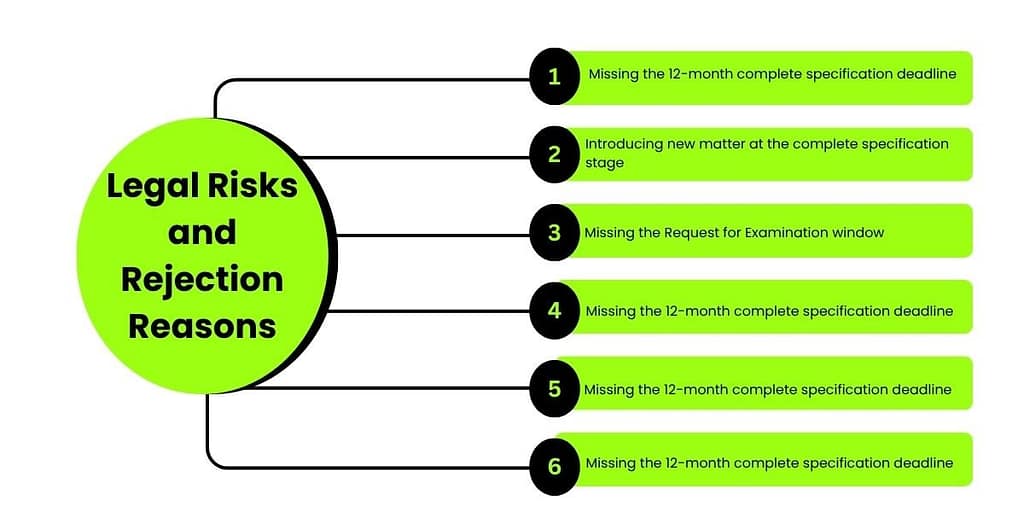
Most provisional filings in India fail not at the drafting stage but at deadline management, where one missed date permanently forfeits the priority claim.
- Missing the 12-month complete specification deadline. Section 9(1) treats the application as abandoned if the complete specification isn’t filed within 12 months — there is no condonation route for this deadline.
- Introducing new matter at the complete specification stage. Features absent from the provisional don’t receive the earlier priority date; if the invention has changed direction substantially, a fresh provisional filing is usually the safer path.
- Missing the Request for Examination window. Filing Form 18/Form 18A late means the application is deemed withdrawn under Section 11B(4); Rule 137 condonation is expressly excluded for this deadline.
- Public disclosure before filing. Demonstrating the invention, publishing details, or pitching without an NDA before the provisional filing date can destroy novelty and support a later revocation.
- Incorrect entity classification. Claiming the ₹1,600 fee slab without valid DPIIT startup recognition, or after a startup exceeds the eligibility thresholds under Rule 2(fb), invites fee-shortfall objections.
- Incomplete Section 8 disclosure. Not filing Form 3 — disclosing corresponding foreign applications — within the prescribed windows is an independent ground the Controller can cite when refusing or later revoking the patent.
Also Read: How to File a Trademark Objection Reply Online in India
Provisional Patent Filing Checklist
Keep this on hand before starting the e-filing session — a missing form is the most common cause of formality objections at the Indian Patent Office.
Provisional Patent Filing Process — Document Checklist
1. Technical Preparation & Search
Phase 1-
Prior Art Search: Patentability/prior-art search report.
-
Technical Disclosure: Technical disclosure write-up with diagrams (for Form 2 drafting) under the provisional patent filing process.
2. Mandatory & Conditional Patent Forms
Phase 2-
Form 1: Application for Grant of Patent, signed by applicant(s).
-
Form 2: Provisional Specification.
-
Form 3: Statement and undertaking under Section 8 (if corresponding foreign applications exist).
-
Form 26: Power of Attorney (if filing through a registered patent agent).
3. Entity Concessions & Legal Rights
Phase 3-
Form 28: Startup/small-entity declaration (to claim the reduced ₹1,600 fee).
-
Proof of Right: Proof of right/assignment deed (if the applicant differs from the inventor).
-
DPIIT Certificate: DPIIT startup recognition certificate (if claiming SIPP scheme benefits).
Frequently Asked Questions
How do I file a provisional patent application in India?
File Form 1 together with Form 2 marked “provisional” through the IP India e-filing portal, paying ₹1,600 (individual/startup/small entity/educational institution) or ₹8,000 (other applicants). The filing date becomes your priority date immediately, and Section 9 gives you 12 months to file the complete specification.
How to file a provisional patent step by step?
Run a prior-art search, draft the provisional specification describing the invention’s core concept, file Form 1 and Form 2 through the e-filing portal, pay the applicable government fee, then track the 12-month statutory deadline to file the complete specification with claims before the priority date lapses.
How much does it cost to file a provisional patent in India?
The government fee is ₹1,600 for individuals, startups, small entities and educational institutions, or ₹8,000 for other applicants, for e-filing up to 30 pages. Professional drafting typically adds ₹8,000–₹25,000, putting the realistic total for the provisional stage around ₹10,000–₹33,000.
How long does it take to file a provisional patent application?
The e-filing submission itself takes a single session once Form 1 and Form 2 are ready, with the application number issuing immediately. Drafting the specification beforehand typically takes 1–3 weeks with a patent agent, depending on technical complexity.
Discover more from EcoLaw
Subscribe to get the latest posts sent to your email.