
- How to Complete the Copyright Registration Procedure in India for Software and Online Content - August 30, 2026
- Provisional Patent Filing Process in India: Complete Guide to Costs, Forms and Deadlines - August 26, 2026
- Trademark Opposition Rules in India: Timeline & Evidence Filing - August 20, 2026
Quick Summary & Executive Takeaway
Under the statutory Trademark Opposition Rules set forth in Section 21 of the Trade Marks Act, 1999, any person can oppose a published trademark within a strict four-month window from the date of advertisement in the Trade Marks Journal, by filing Form TM-O on the IP India portal along with the prescribed fee of ₹2,700 per class (e-filing).
The applicant then has two months to file a counter-statement, failing which the application is deemed abandoned. Both sides exchange evidence under Rules 45, 46 and 47 of the Trade Marks Rules, 2017 before the Registrar fixes a hearing.
Why This Procedure Matters to Your Business
A trademark opposition is where a growing share of Indian brand disputes are actually decided — not in court, but on a Registry calendar. Once the Trade Marks Registry, functioning under the Controller General of Patents, Designs and Trade Marks (CGPDTM), accepts an application and advertises it in the Trade Marks Journal, any business that believes the mark conflicts with its own rights gets exactly four months to act. Miss that window, or mishandle the counter-statement, and the registration proceeds — or your own defence collapses — regardless of how strong the underlying rights actually are. For startup founders protecting a brand name, corporate legal heads managing a trademark portfolio, and HR or marketing teams clearing new product names, the trademark opposition procedure India applicants and opponents must follow under Section 21 and the Trade Marks Rules, 2017 is not legal trivia — it is a filing deadline with direct commercial consequences.
Table of Contents
Trademark Opposition Process in India: Step-by-Step Procedure
The trademark opposition process step by step India follows moves through four fixed stages — notice, counter-statement, evidence, and hearing — and each stage carries its own non-negotiable deadline.
Stage 1: Filing the Notice of Opposition (Form TM-O)
- Under Section 21(1), “any person” may oppose a published mark — you do not need a prior registration; a common-law user, competitor, or even a trade association can file.
- The notice must be filed within four months from the date the mark is advertised or re-advertised in the Trade Marks Journal, per Rule 42 of the Trade Marks Rules, 2017. This period is absolute — the 2017 rules removed the Registrar’s earlier discretion to grant a one-month extension.
- File electronically on the IP India portal using a Class 3 Digital Signature Certificate, or physically (in duplicate) at the relevant Trade Marks Registry office.
- State the application number, class, and grounds — typically absolute grounds under Section 9 (lack of distinctiveness) or relative grounds under Section 11 (conflict with an earlier mark) — with full details of every prior right relied upon.
Stage 2: Counter-Statement Timeline Under Section 21
- The Registrar serves the opposition notice on the applicant.
- Under Section 21(2) and Rule 44, the applicant must file a counter-statement in Form TM-O within two months of receiving the notice, specifically admitting or denying each ground pleaded.
- There is no extension available at this stage. A late or missing counter-statement means the trademark application is deemed abandoned in its entirety — not merely undefended.
Stage 3: Trademark Opposition Evidence Stage Procedure (Rules 45–47)
- Rule 45 – The opponent files evidence by affidavit within two months of receiving the counter-statement, or formally intimates that it will rely solely on the notice of opposition.
- Rule 46 – The applicant files evidence in support of the application within two months of receiving the opponent’s Rule 45 evidence (or waiver).
- Rule 47 – The opponent may file reply evidence, confined strictly to rebutting the applicant’s Rule 46 evidence, within one month. This step is optional, but skipping it risks the Registrar treating the applicant’s unrebutted evidence as admitted.
- Recent rulings, including the Delhi High Court’s decision in Sun Pharma Laboratories Ltd. v. Dabur India Ltd. (2024:DHC:946) and a Madras High Court ruling on Rule 45, have confirmed the Registrar has no discretion to extend these two-month evidence deadlines — a departure from older, more lenient practice under the 2002 Rules.
Stage 4: Hearing and Final Order
- Once evidence closes, the Registrar issues a hearing notice, with the hearing date fixed at least one month later, per Section 21(5).
- Either party may seek an adjournment via Form TM-M (fee ₹900), filed at least three days before the hearing; a maximum of two adjournments of up to 30 days each is typically permitted.
- The Registrar passes a reasoned order — the opposition is either dismissed (mark proceeds to registration) or allowed (application refused).
- Appeals against the Registrar’s order now lie before the jurisdictional High Court, since the Intellectual Property Appellate Board (IPAB) was abolished under the Tribunals Reforms Act, 2021.
Also Read: Trademark Registration Fees in India: Government Cost vs Attorney Fees Explained
Form TM-O Filing Fee and Deadline: Cost & Timeline Breakdown
Government fees for opposition are fixed and modest; the real cost driver is professional time across three or four evidence rounds spread over one to two years.
| Stage | Government Fee (Per Class) | Indicative Professional Fee* | Statutory Deadline |
|---|---|---|---|
| Notice of Opposition (Form TM-O) | ₹2,700 (e-filing) / ₹3,000 (physical) | Varies by firm and complexity | 4 months from Journal advertisement — not extendable |
| Counter-Statement (Form TM-O) | ₹2,700 (e-filing) / ₹3,000 (physical) | Varies by firm and complexity | 2 months from receipt of notice — not extendable |
| Evidence in Support of Opposition (Rule 45) | Nil | Varies by firm and complexity | 2 months from receipt of counter-statement |
| Evidence in Support of Application (Rule 46) | Nil | Varies by firm and complexity | 2 months from receipt of Rule 45 evidence |
| Evidence in Reply (Rule 47) | Nil | Varies by firm and complexity | 1 month from receipt of Rule 46 evidence (optional) |
| Adjournment (Form TM-M) | ₹900 | Nominal | Filed ≥3 days before hearing; max 2 adjournments |
Professional fees are market-determined and not fixed by statute; get a scoped quote before engaging counsel.
In practice, a contested opposition that runs through a full evidence cycle and hearing typically takes two to five years to reach a final order, depending on the Registry’s bench strength and how aggressively either side uses procedural steps like adjournments.
Also Read: How to File a Trademark Objection Reply Online in India
Common Pitfalls, Legal Risks, and Rejection Reasons

Most oppositions are lost on procedure, not merit — the deadlines above are stricter in practice than many businesses assume.
- Treating the four-month window as flexible. It isn’t. Once it lapses, there is no condonation route, and the mark proceeds toward registration.
- Assuming evidence deadlines can be extended. Older guidance, based on the 2002 Rules, suggested a one-month grace period. Current case law has closed that door for both Rule 45 and Rule 46 — file on time or lose the right to file at all.
- Filing a generic counter-statement. A bare denial without specific facts on prior use, adoption date, or distinctiveness weakens the applicant’s position at the evidence and hearing stages.
- Skipping Rule 47 reply evidence by default. Silence on the applicant’s Rule 46 evidence can be read as an admission, since the Registrar may decline to let the opponent contest unrebutted facts at the hearing.
- Miscalculating the Journal publication date, especially for re-advertised marks, which resets the four-month clock and is frequently missed by parties tracking only the original advertisement.
- Ignoring settlement early. Given the two-to-five-year timeline, exploring a coexistence agreement, honest concurrent use claim, or specification amendment before the evidence stage often saves far more than it costs.
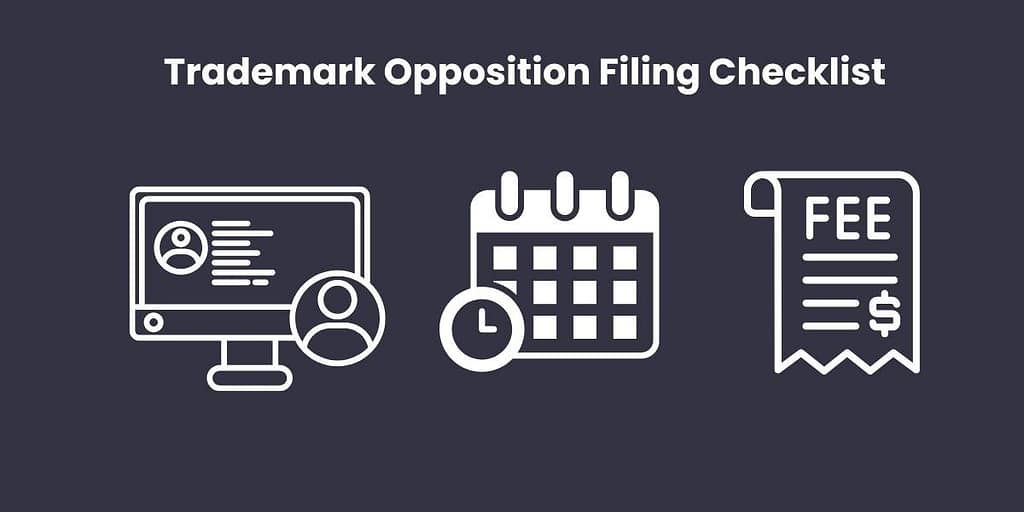
Trademark Opposition Filing Checklist
1. Initial Verification & Legal Grounds
Phase 1-
Application Details: Confirm the application number, class, and exact Journal advertisement date.
-
Filing Window: Calendar the 4-month Form TM-O deadline — no extensions apply under statutory rules.
-
Grounds of Opposition: Draft grounds citing specific sections (Section 9 and/or Section 11) and every prior mark relied upon.
2. Evidence & E-Filing Execution
Phase 2-
Proof of Use: Compile proof of prior use: invoices, GST returns, packaging, ad spend records, registration certificates.
-
Authentication: Obtain a Class 3 Digital Signature Certificate (DSC) for e-filing access.
-
Fee Payment: Pay the ₹2,700 per-class fee via the official IP India payment gateway.
3. Post-Filing Management & Hearing Bundle
Phase 3-
Counter-Statement Window: Diarize the 2-month counter-statement deadline from the exact date notice is served.
-
Evidence Deadlines: Track Rule 45, 46, and 47 statutory deadlines as three separate, final dates.
-
Hearing Preparation: Prepare an indexed hearing bundle — pleadings, affidavits, exhibits, chronology — in three copies.
FAQs
Who can file an opposition against a trademark in India?
Any person can file an opposition under Section 21(1) of the Trade Marks Act, 1999, whether or not they hold a registered mark themselves. This includes individuals, companies, partnerships, trusts, consumer groups, or common-law users of an unregistered mark. No personal or commercial stake needs to be proven.
What is the opposition period for trademarks in India?
The opposition period is four months from the date the mark is advertised, or re-advertised, in the Trade Marks Journal, fixed by Section 21(1) read with Rule 42 of the Trade Marks Rules, 2017. This window is uniform across all classes and applicant types and cannot be extended.
Can a registered trademark be challenged in India?
Yes — a registered trademark can still be challenged through rectification or cancellation proceedings before the Registrar or High Court, typically on grounds of non-use, wrongful registration, or entry without sufficient cause. This is a separate remedy from the pre-registration opposition process under Section 21.
What is the opposition period for a trademark?
The statutory period is a fixed four months from Journal publication, with no discretionary extension since the Trade Marks Rules, 2017 withdrew the Registrar’s earlier power to grant an additional month. Businesses should treat it as an absolute cut-off, not a negotiable target.
Discover more from EcoLaw
Subscribe to get the latest posts sent to your email.