

- How to Complete the Copyright Registration Procedure in India for Software and Online Content - August 30, 2026
- Provisional Patent Filing Process in India: Complete Guide to Costs, Forms and Deadlines - August 26, 2026
- Trademark Opposition Rules in India: Timeline & Evidence Filing - August 20, 2026
In the modern digital economy, a distinctive trademark and brand identity serve as a business’s most valuable commercial asset. Whether it is a disruptive startup or an established enterprise, securing a federally registered trademark for the visual, auditory, or textual elements that distinguish a business from its competitors is a requirement for robust legal safeguarding. Without this strategic trademark and intellectual property protection, a company risks losing its market share, consumer trust, and brand equity to counterfeiters and bad-faith actors.
While businesses frequently confuse the mechanisms of intellectual property rights, they serve distinct legal purposes: trademarks protect brand identifiers (names, logos, slogans); copyrights protect original literary, dramatic, musical, and artistic works; and patents protect novel, non-obvious industrial inventions. For comprehensive corporate asset protection, partnering with a specialized intellectual property protection attorney is critical to navigating these distinct legal frameworks.
Table of Content
Table of Contents
What is a Trademark?
A trademark is a distinctive visual symbol, sign, phrase, word, or combination thereof used by an individual, business organization, or legal entity to uniquely identify the source of its products or services and distinguish them from those of competitors. Under statutory frameworks, a trademark serves as a legal guarantee of consistent quality and commercial origin.
To secure robust market exclusivity, businesses must understand the diverse categories of marks recognized by the Office of the Controller General of Patents, Designs and Trade Marks (CGPDTM).
™ Traditional Trademarks
📝 Word Marks
Consist solely of text, protecting the brand name itself regardless of its font, size, or color (e.g., Google or Apple).
🎨 Device Marks / Logos
Protect the unique visual design, stylized typography, and graphic representation of a brand’s logo.
💬 Taglines / Slogans
Distinctive text phrases used in marketing to reinforce brand recognition (e.g., Nike’s “Just Do It”).
✨ Non-Traditional Trademarks
The evolution of corporate branding has expanded the legal scope of registrable marks to include sensory and dynamic brand identifiers.
🎵 Sound Marks
Distinctive audio mnemonics that trigger immediate brand recall. A premier example is the iconic Airtel custom tune, which achieved registration by proving its inherent distinctiveness.
🎨 Color Combinations
Unique, non-functional color schemes that consumers uniquely associate with a specific brand, such as the distinctive purple shade used by Cadbury.
🎬 Motion Logos
Moving digital graphics or short animations used in digital media that function as source identifiers and strengthen brand recognition.
Decoding Trademark Symbols: ™ vs ® vs ℠
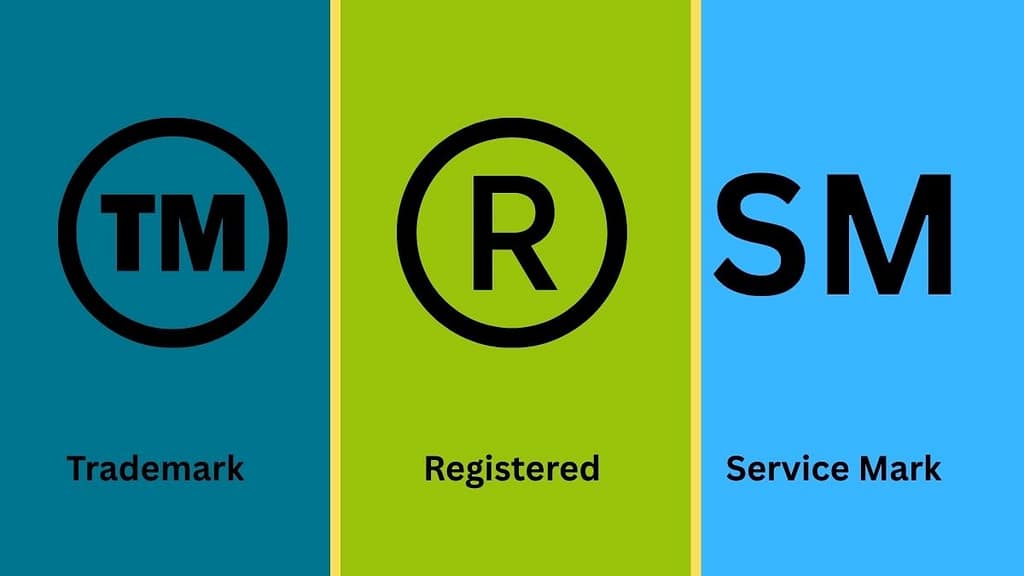
Using the correct trademark symbol is not merely a branding preference—it is a legal statement with specific statutory consequences.
™ Understanding Trademark Symbols
™ The Trademark Symbol
Pending or Unregistered Status: The ™ symbol signifies that the user claims common law rights over the mark. It is commonly used when a trademark application has been filed and is currently pending examination.
Public Notice: Anyone can use the ™ symbol without prior government approval. It serves as a public notice that the business intends to protect the mark and may provide limited common law protection against passing off.
® The Registered Symbol
Absolute Registration Prerequisite: The ® symbol denotes an officially registered trademark.
Strict Conditional Use: This symbol can only be legally used after the CGPDTM issues the formal Registration Certificate. It grants the proprietor nationwide statutory exclusivity and the right to initiate infringement proceedings.
℠ The Service Mark Symbol
Service Sector Focus: The ℠ symbol functions similarly to the ™ symbol but is specifically intended for unregistered or pending marks representing services, such as consultancy, hospitality, education, financial services, or software-as-a-service, rather than physical goods.
⚖️ The Ultimate Comparison Table: ™ vs ®
| Feature | ™ Symbol | ® Symbol |
|---|---|---|
| Legal Meaning | Unregistered or Pending Trademark | Officially Registered Trademark |
| Registration Requirement | None (Application can be pending or unfiled) | Mandatory (Must hold an active Registration Certificate) |
| Legal Protection Status | Limited protection under Common Law (Passing Off) | Maximum statutory protection under the Trade Marks Act |
| Geographic Scope | Typically localized to active geographical usage | Nationwide exclusivity across all states and territories |
| Misuse Penalties | None | Strict civil and monetary penalties under Section 107 |
Legal Warning: The Danger of Misuse
Improper utilization of the ® symbol carries severe legal liabilities. Under Section 107 of the Trade Marks Act, 1999, any person who falsely represents that a trademark is registered when it is not faces criminal prosecution. This offense is punishable by imprisonment for a term extending up to three years, a substantial monetary fine, or both.
The Trade Marks Act, 1999 Explained
The statutory foundation governing brand protection in India is the Trade Marks Act, 1999. This legislation outlines the criteria for registration, maintenance, and enforcement of proprietary marks.
🚫 Absolute Grounds for Refusal (Section 9)
The CGPDTM will summarily reject trademark applications that fail to meet baseline distinctiveness. Section 9 bars the registration of marks that fall into the following categories:
📝 Descriptive Marks
Words that merely describe the kind, quality, quantity, or intended purpose of the goods or services. For example, attempting to register “Cold & Sweet” for ice cream would generally be refused because it directly describes the product’s characteristics.
📦 Generic Terms
Common everyday words that identify the product category itself cannot be monopolized as trademarks. For instance, trying to trademark the word “Laptop” for computers would be rejected because it is a generic term.
⚠️ Deceptive or Scandalous Marks
Marks that are likely to deceive the public, create confusion regarding the nature or origin of goods and services, or contain content that is offensive, scandalous, or hurtful to religious sentiments are prohibited from registration.
⚖️ Relative Grounds for Refusal (Section 11)
Even if a mark is distinctive, Section 11 prevents its registration when it conflicts with pre-existing intellectual property rights. The trademark registry may issue an objection if the proposed mark falls into the following categories:
🔍 Identical or Deceptively Similar Marks
A trademark may be refused if it is visually, phonetically, or conceptually identical or deceptively similar to an earlier registered trademark covering similar goods or services. Such similarities can create an unfair advantage or dilute the rights of the existing trademark owner.
⚠️ Likely to Cause Confusion
Registration may also be denied where the proposed mark is likely to cause confusion among average consumers regarding the true origin, affiliation, sponsorship, or source of the goods or services, potentially misleading the public.
Infringement vs. Passing Off
Understanding the procedural divide between these two legal remedies is critical for brand enforcement.
⚖️ Infringement vs. Passing Off
Understanding the distinction between statutory infringement and common law passing off is essential when enforcing trademark rights.
Statutory Infringement: Applicable only to registered trademarks under Section 29 of the Act. If an unauthorized party uses a deceptively similar mark in the course of trade, the registered proprietor can initiate an infringement suit. The burden of proof is significantly lower, and statutory remedies include ex-parte injunctions, delivery-up of infringing goods, and damages.
Common Law Passing Off: The sole remedy available to unregistered trademark holders. Passing off is a common law tort action rooted in equity. To win a passing-off suit, the plaintiff faces a high burden of proof: they must conclusively establish existing business goodwill, misrepresentation by the defendant, and actual or potential damage to their reputation.
Current 2026 Timeline & E-Filing Process Updates
The procedural landscape for securing trademark protection has evolved rapidly. Driven by digital transformation mandates, recent statutory amendments have optimized the workflow on the official IP India e-filing portal online.
Accelerated Turnarounds: Due to updated automated screening algorithms deployed by the registry, the initial examination phase has dropped significantly. Clean applications with spotless documentation now receive their examination reports within 30 to 45 days of filing.
E-Filing Platform Rules: The upgraded digital portal features mandatory integration with the updated Nice Classification multi-class filing fees database. The system enforces dynamic auto-validation of goods and services descriptions, instantly flagging non-standard terms to eliminate classification errors before submission.
Digital & Virtual Assets: To address modern tech ecosystems, recent updates explicitly protect brand footprints across virtual worlds, digital assets, and AI-generated contexts. Brand owners can now file specifically under modified sub-classes to protect software, downloadable digital goods, and virtual store representations.
MSME & Startup Benefits: The Ministry continues to incentivize early-stage compliance by offering a 50% statutory fee concession for registered startups, individual innovators, and micro-enterprises, making comprehensive brand protection highly accessible.
Step-by-Step Brand Protection Checklist
To navigate the application lifecycle efficiently and avoid costly litigious delays, follow this structured blueprint
1. Conduct a Public Search
Before filing, perform a comprehensive public search on the official IP India e-filing portal online database. Check for phonetic, visual, and conceptual similarities to eliminate potential Section 11 conflicts.
2. Classify Goods and Services Properly
Identify the appropriate classes using the Nice Classification system, which divides goods and services into 45 distinct categories. For diverse operations, utilize a multi-class filing strategy to protect your brand across different commercial sectors.
3. Assemble Digital Documentation
Compile your organizational documents, user affidavits (if claiming prior use), and logo files. Ensure authorization is signed using a secure, verified Digital Signature Certificate (DSC) to enable direct e-filing.
4. Monitor the Statutory Opposition Window
Once an application clears the examination phase, the registry publishes the mark in the national Trade Marks Journal. This opens a strict 4-month statutory opposition window during which any third party can contest the registration. If no oppositions are filed, or if an opposition is successfully defended, the certificate is issued.
FAQ Section
Can I use the ® symbol as soon as I file a trademark application?
No. You cannot use the ® symbol immediately upon filing. You may only use the ™ symbol while your application is pending review. The ® symbol can legally be deployed only after the CGPDTM formalizes the application and issues the official Trademark Registration Certificate. Premature use violates Section 107 of the Trade Marks Act, 1999.
How long does a trademark registration last in India before renewal?
A trademark registration is valid for a period of 10 years from the initial date of application. Unlike patents or copyrights, trademark protection can be extended indefinitely. The proprietor must file a renewal application along with the prescribed statutory fees every 10 years within the window preceding the expiration date.
What is the difference between a trademark and a registered company name?
A registered company name is a corporate entity identifier approved by the Ministry of Corporate Affairs (MCA) to grant corporate existence to a legal entity. It does not grant commercial marketing exclusivity. A trademark, conversely, is an intellectual property asset granted by the CGPDTM that explicitly protects commercial brand names, logos, and slogans, preventing competitors from trading on your business goodwill.
Standard Legal Disclaimer
Disclaimer: The information provided in this article does not, and is not intended to, constitute formal legal advice. All content, text, data, and materials available in this guide are for general informational and educational purposes only. Readers should contact their legal counsel or a qualified intellectual property protection attorney to obtain specific legal advice regarding any particular intellectual property matter or registration process.
Discover more from EcoLaw
Subscribe to get the latest posts sent to your email.